For the record, I'm neither an academic nor a scholar, and admittedly, I've never been to many of the places posted here. So if someone should find a mistake, or believe I omitted something, please feel free to email me and I'll correct it.

I can be contacted at dms2_@hotmail.com.

Showing posts sorted by date for query byblos. Sort by relevance Show all posts

Sunday, September 22, 2019

LEBANON

Image result for lebanon
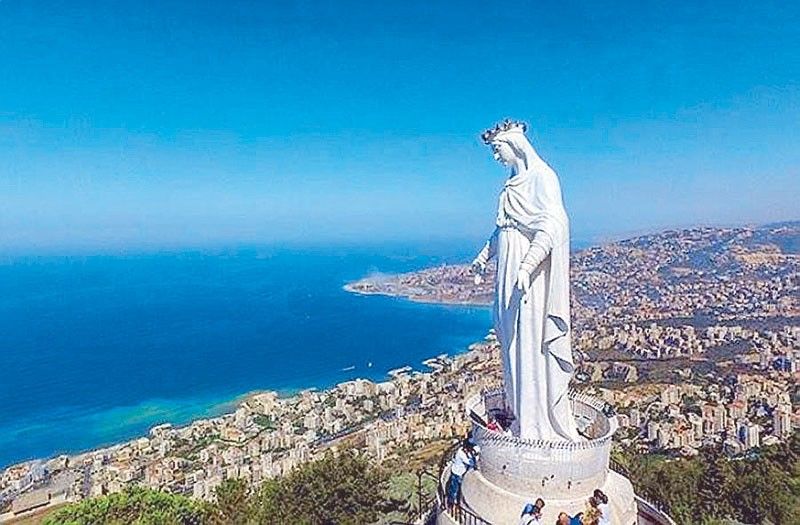
Shrine of Our Lady of Lebanon, Harissa, courtesy, PhilStar.com
Lebanon is located in the center of the eastern Mediterranean coast and is even smaller than Israel. Aside from the Mediterranean, it is bounded on the south by Israel and on the east and north by Syria. Throughout history, Lebanon has constantly had to fight for its ancient Phoenician/Maronite Christian identity, especially against Arab Muslim colonialism, but have only been partially successful - since independence in 1943, by law, the president has to be a Maronite. But on the other hand, the prime minister and speaker of the parliament have to be Arab Muslims and as such, the whole of Lebanon, including the Maronites, was forced to be a full member of the Arab League since its founding in 1945. Since then, the Arabs have successfully brainwashed the Maronites into thinking that they are Arab Christians. Those who refused this identity, were often killed. This was especially so in the 1970s during the civil war when the PLO would massacre approximately 100,000 unarmed Maronite men, women, and children, with the tacit approval of the United Nations. Since the war, the indigenous Lebanese have made impressive economic gains, on a par with that of Europe and Israel, in spite of the fact that they are still persecuted and harassed by the Arabs and are constantly under the watchful eye of Hezbollah.

Before the introduction of Christianity to Lebanon, the Phoenicians, as with most ancient peoples of the time, were pagans. During this period, Phoenicia was never a single unified country, but was made up of four main autonomous city-states, each ruled by their own kings, the two leading city-states being Tyre and Sidon. Byblos and Arwad were next in importance (see Byblos). During the reigns of David and Solomon in Israel, both Tyre and Sidon had mixed Israelite and Phoenician populations even though they were often ruled by Phoenician kings. Sometimes, the kings themselves even had mixed ancestry, for example King Hiram of Tyre who assisted King Solomon in building the Temple in Jerusalem. The following is a list of the ancient Phoenician kings centered in Tyre:

Agenor (ruled from c. 1500 BCE), Phoenix, Eri-Aku, Abi-Milku, Aribas, Baal Termeg, Baal, Pummay, (the list of the next century is unclear and it is resumed again in the early 10th century BCE when Sidon, which was formerly ruled by Ahiram, joined Tyre to form a union, but the kings continued to rule from Tyre), Abibaal, Hiram I, Baal Eser I, Abdastartus, Astartus, Deleastartus, Astarymus, Phelles, Itobaal I, Baal Eser II, Mattan I, Pygmalion;

Under Assyrian rule - Itobaal II, Hiram II, Mattan II, Itobaal III who ruled an independent Tyre;
Babylonian rule - Baal II, Yakinbaal, (monarchy overthrown in favor of judges), Chelbes, Abbar, Mattan III and Ger Ashtari jointly, Baal Eser III, Hiram III who restored the monarchy;

Persian rule - Mattan IV, Boulomenus, Abdemon, the Cypriot Evagoras of Salamis who briefly united Tyre with Cyprus, Eugoras, Azemilcus who reigned during the siege of Alexander the Great, Abdolunim.

Thereafter, the territory of Tyre alternated between Greek and Roman rule.
According to some histories, Saint Peter was the first to evangelize the Phoenicians whom he affiliated to the ancient patriarchate of Antioch. Paul also preached in Lebanon, having lingered with the early Christians in Tyre and Sidon. Even though Christianity was introduced early to Lebanon, its spread was very slow, particularly in the mountainous areas where paganism was still unyielding.
The earliest indisputable tradition of Christianity in Lebanon can be traced back to Saint Maron in the 4th century AD, being of Greek/Eastern/Antiochian Orthodox origin and the founder of national and ecclesiastical Maronitism. Saint Maron adopted an ascetic and reclusive life on the banks of the Orontes river in the vicinity of Homs, Syria and founded a community of monks which began to preach the gospel in the surrounding areas.  
After the Arab conquest and occupation in the 7th century, Saint John Maron, a monk of Sarmin in Syria,  led his followers to the Lebanese mountains to the village of Kfar Hai and there, consolidated Lebanon’s Maronite heritage, often protected by the Marada warriors who were also Maronites. The following is a list of the patriarchs since his time (Druze leaders will be covered in a different posting):

John Maron, Kyros, Gabriel, John Maron II (transferred the patriarchal seat to Yanouh then to Byblos), Youhanna, Gregorius, Stefanos, Mark, Eusebius, Youhanna II, Yeshu, David, Gregorius II, Theophilactus, Yeshu II, Domitius, Ishaq, Youhanna III, Shamun, Urmia, Youhanna IV, Shamun II, Shamun III;

Crusader period (1099-1305) – (During the Crusades, the Maronites went into communion with the Roman Catholic Church.) Yousef al Jirjisi, Butros (the patriarchate briefly moved to the town of Mayfuq but then returned to Byblos), Gregorius, Yacoub, Youhanna V, Boutros II, Boutros III, Boutros IV, Urmia Amchiti, Daniel, Youhanna VI, Shamun IV, Yacoub II, Daniel II, Luqa and Urmia III (the two patriarchs, ruling at the same time, caused a schism in the church but it reunified after the death of Urmia in 1297), Shamun V succeeded and led the Maronites into the:  

Mameluke Egyptian period (1305-1516) - Shamun V, Youhanna VII, Gabriel II, David II, Youhanna el Jaji (transferred the patriarchal seat to Kannoubine), Yacoub el Hadathi, Yousef el Hadathi;

Ottoman Turkish period (1516-1918) - Seman el Hadathi, Mousa Saade el Akari, Mikhail al Rizzi, Sarkis el Rizzi, Yousef el Rizzi, Youhanna Makhlouf, Gewargios Omaira al Duwaihi, Yousef Halib el Akouri, Youhanna el Bawab, Gerges Beseb’eli, Estafanos el Duwaihi, Jibrail II, Yacoub Awad, Yousef V el Khazen, Seman Awad, Tobias el Khazen, Yousef Estefan, Mikhail Fadel, Philip Gemayel, Yousef Tyan, Youhanna Helou, Yousef Hobaish (moved the patriarchal seat to Bkerke), Yousef IX el Khazen, Boulos Massad, Youhanna el Hajj, Elias Peter Hoayek led the Maronites from Ottoman to French rule after WWI;

French rule (1918-1943) – Elias Peter Hoayek, Anthony Peter Arida (led from French rule to independence);

Independence – Anthony Peter Arida, Paul Peter Meouchi, Nasrallah Boutros Sfeir, Bechara Boutros al Rahi (the present incumbent).

Sunday, September 1, 2019

BYBLOS, LEBANON

byblos
Byblos, courtesy, Wikipedia

[exerpts taken from Wikipedia, curate.nd.edu, and Maronite-heritage.com]

The ancient city of Byblos, which the Arab occupation authorities refer to as “Jbeil”, is a town in Lebanon, (the ancient Phoenicia) about 26 miles north of Beirut. It is today, almost totally inhabited by indigenous Lebanese, descendants of the ancient Phoenicians, the Maronites. With a population of 40,000, it is the largest city in the Mount Lebanon region and is also considered one of the oldest continuously inhabited cities in the world. It is also said that Byblos was the first city built in Phoenicia. Beginning approximately 10,000 years ago, before the arrival of the Phoenicians in, what is now Lebanon, the town was actually known by several names. When the Phoenicians arrived, they renamed it “Gebal” and made it their first capital. A new social structure was built with each Phoenician city-state in Lebanon worshipping their own gods. The god of Gebal was known as Baalat Gebal to which, the local inhabitants built a temple. However, one of the most important local monuments of this period was the temple of Resheph, a Canaanite war god.
Gebal remained the Phoenician capital for 1500 years until it eventually moved to Tyre. From Gebal, they conducted a sea-trading empire, trading with the lands around the Mediterranean and beyond. The use of the alphabet was spread by Phoenician merchants through this maritime trade, especially into parts of North Africa and Europe. The oldest known representation of the Phoenician alphabet is inscribed on the sarcophagus of King Ahiram of Gebal, dating approximately to the 11th century BCE. 
Beginning in the 8th century BCE, Gebal was ruled by the following kings: Sibittibaal, Urumilki, Milkiasaph, and Yehowmelek who were all tributary to the invading and conquering Assyrian Empire. In 539 BCE, Phoenicia was conquered by the Persian Achaemenid Empire (538–332 BCE) and Gebal became the fourth of four Phoenician vassal kingdoms established by the Persians – the first three being SidonTyre, and Arwad. The year 332 BCE came the Greek conquest under Alexander the Great and Greek influence became widespread. Thus, the name “Gebal” was Hellenized and renamed “Byblos” (from where the word “Bible” originated). Mediterranean trade continued unhampered and coins came to be used as currency. Byblos became the import-export center of papyri – so much so that papyri was known as “Byblos material”. In addition, the temple of Resheph was elaborately rebuilt, and the city, though smaller than its neighbors, was a center for the cult of Adonis. In the 3rd century, a small but impressive theater was constructed. During the Roman period, Byblos grew rapidly. Christianity was introduced by Saint John Mark, an apostle of Jesus Christ, and Byblos became an independent bishopric. By the first and second centuries, the Phoenicians produced many scholars and academics, one of the most prominent being Philo of Byblos who wrote a detailed history of Phoenicia.
In 636, the Arab Muslims conquered Phoenicia and thus began a slow process of Arabization of the area. By 1104 however, Phoenicia fell to the Christian Crusaders with whom, the Maronites formed an alliance. Work on the Church of St. John-Mark of Byblos, later used for Maronite worship, started during the Crusader era in 1116. It was partially destroyed by an earthquake in 1176 AD. When Islamic forces captured the city a decade later, the church was transformed into a set of stables. After the final defeat of the Crusaders by the Muslim Mamluk rulers of Egypt and their conquest of the regions of the Levant, the Maronites of Byblos, like the rest of Lebanon, often came under attack by their new overlords. But in 1357, they became divided against themselves – those of the Byblos area against those of the Bsharre area just to the east. Taking advantage of the situation, the Mamluks invaded Byblos and the nearby town of Batroun in 1367, destroying these and the surrounding villages, and burning their Patriarch alive. Many people escaped to Cyprus. With the Mamluks now the clear masters of the land, and Byblos invaded by Arab settlers, the town was now more often referred to as “Jbeil”, the Arabized form of “Byblos”.

The eparchy of Jbeil was erected on June 12, 1673 and its canonical erection was confirmed in the Maronite Synod of Mount Lebanon in 1736. In 1768 it was united to the Eparchy of Batroun. Later, the Church of Saint John-Mark was given to the Maronites as a gift by the Druze Prince Youssef Chehab after they aided him in capturing the city. In 1848 the seat of the Eparchy Jbeil-Batroun became the seat of the Maronite Patriarch. After the violence in 1860 between the Maronites and the Druze, the Maronites set out on an education program, for both boys and girls. In 1863, following the orders of her superiors, Saint Rafqa, a Maronite nun, went to the School of the Monastic Order in Byblos, where she spent more than a year, teaching girls education and faith. There, she remained with success until she was transferred to another village the following year where, again, she educated the local girls in academic studies.
Since the 1920s, Byblos has been the site of several archaeological excavations. In the 60s and 70s, it was a major tourist destination, often being visited by the likes of Marlon Brando and Frank Sinatra. On June 9, 1990, the Eparchy of Jbeil-Batroun was separated and Jbeil became an independent eparchy.  
Today, despite the Maronites in Lebanon, and those of Byblos/Jbeil in particular, being under the constant watchful eye of Hizbollah and their allies, Byblos is still managing to re-emerge, with determination, as an upscale tourist hub. With its ancient portPhoenician, Roman, and Crusader ruins, sandy beaches, and surrounding picturesque mountains, as well as its fish restaurants, open-air bars, and outdoor cafes, the city makes an ideal tourist destination. Other sites include:
The Church of Saint George, the church of Mar Yacoub, the church of Saint Peter, Ain el-Malik or King’s Spring, the L-shaped Temple erected about 2700 BCE, the Temple of the Obelisks originally built between 1600–1200 BCE, the necropolis of the kings of Byblos including King Ahiram, the Roman theater built around AD 218, the Byblos Wax Museum, the Byblos Fossil Museum, the old medieval part of Byblos, and the old market.
In addition, there is an annual summer music festival that takes place in the historic quarter.