For the record, I'm neither an academic nor a scholar, and admittedly, I've never been to many of the places posted here. So if someone should find a mistake, or believe I omitted something, please feel free to email me and I'll correct it.

I can be contacted at dms2_@hotmail.com.

Sunday, October 27, 2019

CYRENAICA

Related image
Jebel Akhdar, Benghazi region, Cyrenaica; courtesy, Trip Advisor
Cyrenaica is an ancient region covering the eastern half of, what is today, Arab-occupied Libya, and named after the ancient Berber (Amazigh) city of Cyrene (modern day Shahat) located on the coast. The Berbers were, of course, the original inhabitants of Cyrenaica founding a number of cities and settlements, both on the coast, and especially in the inland oases such as Kharga, Siwa (today in westernmost Egypt), Jerabub, and Awjila where remnants of their languages are still found. The area was somewhat known to the ancient Egyptians who knew it as a place of pastoral tribes and olive trees. In later antiquity, Cyrenaica came under the control of the Greeks, thus becoming home to many Greek immigrants. Later, it passed to the Romans. Under Roman rule, Cyrenaica became known as Pentapolis or the "Five Cities", for the five major cities of the area – Cyrene, Apollonia (today Mersa Susa), Arsinoe (today Tocra), Berenice (today Benghazi), Balagrae (al Bayda), and Barce (Marj). It formed part of the Roman province of Crete and Cyrenaica, later divided into Libya Pentapolis and Libya Sicca. In modern times, Cyrenaica came under the rule of Italy and later Britain. In 1951, the Europeans left and the area became incorporated into the Arab Kingdom of Libya. The indigenous Berbers were left as second class citizens at which point, they remain to this day.

After the Arabs completed the conquest of Egypt in 642, they started to raid the indigenous Amazigh territory of Cyrenaica as a starting point for the rest of North Africa which they called Bilād al-Maghrib (“Lands of the West”) or simply the 
Maghrib. In 705 this region became a province of the Muslim empire then ruled from Damascus by the Arab Umayyad caliphs (661–750) but it managed to retain its indigenous Berber character. But slowly but surely, they became Islamized and in part also Arabized. They were neither forcibly converted to Islam nor systematically missionized by their conquerors. Largely because its teachings became an ideology through which they justified both their rebellions against the caliphs and their support of rulers who rejected caliphal authority, Islam gained wide appeal and spread rapidly.
One of the major cities in Cyrenaica, Benghazi, has historically been indigenous and was one of the centers of Berber civilization. However, in the 11th century, the Arab Sa'ada tribe from the Bani Salim invaded and occupied Cyrenaica, including Benghazi, resulting in its control by various branches of the tribe. Benghazi and its surrounding areas were controlled by the Barghathi tribe.
In the 12th century, the area around the town of Ajdabiya was described by the Arab geographer Muhammad al-Idrisi as a place where “tribes of the Berber wander about in great numbers”.
A short-lived Berber state existed in Cyrenaica between 1911 and 1912. During the 1980s, substantial Berber minorities continued to play important economic and political roles, their second class status notwithstanding. After the revolution that overthrew Qaddafi, the political structure was reorganized – with great difficulty but with the occupying Arabs still in charge. In the Cyrenaican parliament, the Amazigh were supposed to get two seats as were the Tibu and Tuareg minorities, which registered candidates. Six seats were reserved for women. The Amazigh demanded from the Arabs equal rights. The General National Congress (GNC) assembly, Libya's new parliament, debated Amazigh demands but reached no agreement.
Today, the people of the area are mainly of mixed Berber and Arab descent. So much so, that many, if not a majority, of the indigenous Cyrenaicans, would often scorn their Berber identities. However, no one can change their ancestry and the people of Cyrenaica are still Berber even if in name only.
Indigenous sites in the area, aside from those mentioned above, include:
The Slontha Temple, a small, ancient, temple dating to the period before the Greek occupation; it was partially damaged during flooding due to heavy rain, but was restored in 1993. Located in the village of Aslanta Lasamisis, approximately 15 miles south of al-Bayda, the temple is hidden high in the Green Mountain's groves. It was first mentioned by G. Haimann in 1886. J. W. Gregory, Professor of Geology at the University of Glasgow, came across the site when he was studying the area in 1911. The temple is rich in carvings of human faces, unusual human figures and animals, disembodied heads, and slender bodies engraved directly onto the rocks, in a style totally unique to the temple. Some of these figures, unlike other ancient representations of the surrounding cultures, are in a seated position, in what appears to be a deeply religious gathering, probably in association with the worship of the dead. Burials and statues in seating position, are characteristic of several Berber cemeteries of the time.
The Jebel Akhdar mountain range extends parallel to the coast from the Gulf of Sidra to the Gulf of Bomba and reaches an elevation of 2860 feet. The southward slopes of the Jebel Akhdar are occupied by the Mediterranean dry woodlands and steppes, a transitional ecoregion lying between the Mediterranean climate regions of North Africa and the hyper-arid Sahara Desert. The lower Jebel el-Akabah lies to the south and east of the Jebel Akhdar. The two highlands are separated by a depression. This eastern region, known in ancient times as Marmarica, is much drier than the Jebel Akhdar and here the Sahara extends to the coast. Historically, salt-collecting and sponge fishing in the Jebel were more important than agriculture. 
The Libyan Desert, located south of the coastal highlands of Cyrenaica is a large east-west running depression, extending eastward from the Gulf of Sidra into Egypt. This region includes the Great Sand Sea and the Calanshio Sand Sea.
The Marj Plain is a level plateau that is separated from the coastal plain by a steep escarpment.   
The Garrigue shrublands occupy the non-agricultural portions of the coastal plain.
The deltaic patches at Susa and Derna.
Ras al Hillal Bay. 

Sunday, October 20, 2019

FEZ


Image result for berber fez, morocco
Fez, courtesy, Berber Dream Tours
Fez is the second largest city in Morocco after Casablanca with a population of 1.4 million (2014). It is located in the northern part of the country (northeast of the Atlas Mountains) and serves as the capital of the Fez-Meknes administrative region. It is also centrally located among most Moroccan population centers. Even though Fez is often described as an “Arab” city, it is, in fact, approximately 33% indigenous Berber, of various tribes. In addition, there are the so-called “Arabized Berbers” who make up approximately 54% of the population. They are either of mixed Arab and Berber ancestry, or Berbers who have taken on Arab culture and identity. Either way, the Arabized Berbers despise their own indigenous Berber identity and identify more with the occupying Arabs. Just as there are self-hating Jews in the world, so there are self-hating Berbers.
The foundation of the city of Fez is said to have been established by the Arab Idrisid dynasty in 789 but named after the Berber banu Fazaz tribe who inhabited the site. Berber emigration to the city occurred from Muslim Spain, a.k.a. Andalusia, in 817–818 after they were expelled after a rebellion against the ruling Arab Umayyad dynasty of Córdoba. They established the Adwat Al Andalus quarter of the city. However, they were followed by 2000 Arab families of colonists from Kairouan (modern Tunisia) after another rebellion in 824 and who established the Adwat Al Qarawiyyin quarter.
In the 10th century, Fez, which at that time, was ruled by the Berber Zenatas, was contested by the Arab Ummayads of Spanish Cordoba and the Idrisids on the one hand, and the Arab Fatimid Caliphate of Tunisia on the other. The Fatimids proved victorious and took the city in 927, expelled the Idrisids, and installed the Berber Miknasa, a branch of the Zenata, over the city. The Miknasa were, in turn, driven out in 980 by the Berber Maghrawa, another branch of the Zenata and ally of Córdoba. It was in this period that the Andalusian ruler Almanzor commissioned the Maghrawa, under their emir Dunas al Maghrawi, to rebuild and refurnish the Al-Kairouan mosque, giving it much of its current appearance.
In 1070, the Berber Almoravid dynasty under ibn Tashfin conquered the city and great Islamic works were initiated throughout the city and their domain. Under Almoravid patronage the largest expansion and renovation of the al-Kairouan Mosque took place (1134-1143) and Fez also acquired a reputation for Maliki legal scholarship; the works of Abu Imran al Fassi were well known. The city also became an important centre of trade. Almoravid impact on the city's structure was such that the second Almoravid ruler, Yusuf ibn Tashfin, is often considered to be the second founder of Fez.
Like many Moroccan cities, Fez was greatly enlarged during the Berber Almohad Caliphate and saw its previously dominating rural aspect lessen. At the start of the 13th century they broke down the Idrisid city walls and constructed new ones, which covered a much wider space. These Almohad walls exist to this day as the outline of Fes el Bali quarter. Under Almohad rule the city grew to become one of the largest in the world with an estimated population of 200,000.
In 1250, Fez became capital of the Berber Marinid Sultanate. In 1276, the Marinid Sultan Abu Yusuf Yacub, who was known as a tolerant ruler who personally intervened to prevent the attempted annihilation of the local Jewish community after a massacre that took place there, established the neighborhood of Fes Jdid which he made the dynasty’s administrative and military center. Fez reached its golden age during this time attracting Berber villagers from the surrounding area. The ruling dynasty initiated numerous building projects in the city, such as the madrasas: the Saffarin (the first), Al Attarine, Mesbahiyya, Sahrij, and the Bou Inania; and mosques: the Great Mosque of Fes Jdid built in 1279, the Abu al Hassan, the Chrabliyine beginning in 1342, the al-Hamra from 1350, the Lala Ghariba in Fes Jdid, and the Bab Guissa from the reign of Abu al-Hassan (1331-1351) (modified in later centuries). Other projects included, the Dar al Magana water clock. The city also became a major travel destination and throughout this period, was often visited by great Islamic Berber scholars such as Ibn Batuta in the 14th century. The Marinids also spread the teachings of the former Arab ruler Idris I and encouraged sharifism, financing sharifian families as a way to legitimize their (in essence secular) rule. Soon, hundreds of families throughout Morocco claimed descent from Idris I, especially in Fez and the nearby Rif mountains.
The Moroccan Revolt in 1465 eventually resulted in the overthrow of the last Marinid sultan nine years later. The dynasty was then replaced by their relatives, the Wattasids, who faithfully (but for a large part unsuccessfully) continued Marinid policies. By 1549, the Arab Saadi dynasty overthrew the Wattasids. In 1576, Fez was briefly conquered by the Ottoman Turks with the help of their Arab allies. Fez remained however under Saadi rule til the present day. During this time period, the indigenous Berbers were often relegated to second class citizenship, their practice of Islam notwithstanding. In fact, as relatively recent as 1912, when Morocco had just come under French rule, the student body at the University of Al Qaraouiyyin, founded by Arabs in the 9th century, were strictly segregated between Arab and Berber students. During the French and Spanish occupation of Morocco in the early 20th centuries, the Berbers of Fez, as with the rest of Morocco, were at the forefront of the fight for independence. Their contributions to Moroccan independence and society still did not improve their situation and only recently, was the Berber language even recognized.

Indigenous sites in Fez (aside from those mentioned above) include:
The Bab el Amer Gate leading to the Fes Jdid quarter;
The Bab Bou Jeloud Gate built in the 12th century, gives access to the main street leading to the Al Qarawiyyin;
Nearby is the former Almoravid citadel;
The Chouara Tannery;
The tombs of the Marinids built in the 14th century;
Coin Berber rug shop in the Medina;
And the Al Batha Museum founded by the Berber writer Ahmed Sefrioui.

Sunday, September 22, 2019

LEBANON

Image result for lebanon
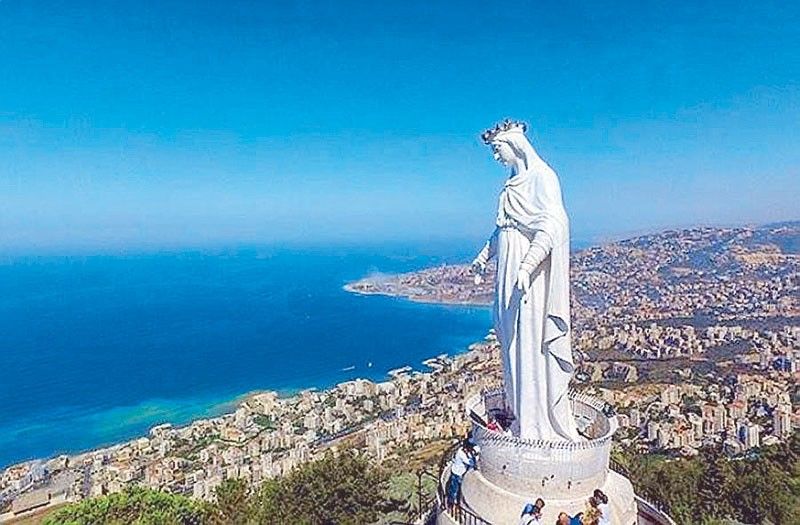
Shrine of Our Lady of Lebanon, Harissa, courtesy, PhilStar.com
Lebanon is located in the center of the eastern Mediterranean coast and is even smaller than Israel. Aside from the Mediterranean, it is bounded on the south by Israel and on the east and north by Syria. Throughout history, Lebanon has constantly had to fight for its ancient Phoenician/Maronite Christian identity, especially against Arab Muslim colonialism, but have only been partially successful - since independence in 1943, by law, the president has to be a Maronite. But on the other hand, the prime minister and speaker of the parliament have to be Arab Muslims and as such, the whole of Lebanon, including the Maronites, was forced to be a full member of the Arab League since its founding in 1945. Since then, the Arabs have successfully brainwashed the Maronites into thinking that they are Arab Christians. Those who refused this identity, were often killed. This was especially so in the 1970s during the civil war when the PLO would massacre approximately 100,000 unarmed Maronite men, women, and children, with the tacit approval of the United Nations. Since the war, the indigenous Lebanese have made impressive economic gains, on a par with that of Europe and Israel, in spite of the fact that they are still persecuted and harassed by the Arabs and are constantly under the watchful eye of Hezbollah.

Before the introduction of Christianity to Lebanon, the Phoenicians, as with most ancient peoples of the time, were pagans. During this period, Phoenicia was never a single unified country, but was made up of four main autonomous city-states, each ruled by their own kings, the two leading city-states being Tyre and Sidon. Byblos and Arwad were next in importance (see Byblos). During the reigns of David and Solomon in Israel, both Tyre and Sidon had mixed Israelite and Phoenician populations even though they were often ruled by Phoenician kings. Sometimes, the kings themselves even had mixed ancestry, for example King Hiram of Tyre who assisted King Solomon in building the Temple in Jerusalem. The following is a list of the ancient Phoenician kings centered in Tyre:

Agenor (ruled from c. 1500 BCE), Phoenix, Eri-Aku, Abi-Milku, Aribas, Baal Termeg, Baal, Pummay, (the list of the next century is unclear and it is resumed again in the early 10th century BCE when Sidon, which was formerly ruled by Ahiram, joined Tyre to form a union, but the kings continued to rule from Tyre), Abibaal, Hiram I, Baal Eser I, Abdastartus, Astartus, Deleastartus, Astarymus, Phelles, Itobaal I, Baal Eser II, Mattan I, Pygmalion;

Under Assyrian rule - Itobaal II, Hiram II, Mattan II, Itobaal III who ruled an independent Tyre;
Babylonian rule - Baal II, Yakinbaal, (monarchy overthrown in favor of judges), Chelbes, Abbar, Mattan III and Ger Ashtari jointly, Baal Eser III, Hiram III who restored the monarchy;

Persian rule - Mattan IV, Boulomenus, Abdemon, the Cypriot Evagoras of Salamis who briefly united Tyre with Cyprus, Eugoras, Azemilcus who reigned during the siege of Alexander the Great, Abdolunim.

Thereafter, the territory of Tyre alternated between Greek and Roman rule.
According to some histories, Saint Peter was the first to evangelize the Phoenicians whom he affiliated to the ancient patriarchate of Antioch. Paul also preached in Lebanon, having lingered with the early Christians in Tyre and Sidon. Even though Christianity was introduced early to Lebanon, its spread was very slow, particularly in the mountainous areas where paganism was still unyielding.
The earliest indisputable tradition of Christianity in Lebanon can be traced back to Saint Maron in the 4th century AD, being of Greek/Eastern/Antiochian Orthodox origin and the founder of national and ecclesiastical Maronitism. Saint Maron adopted an ascetic and reclusive life on the banks of the Orontes river in the vicinity of Homs, Syria and founded a community of monks which began to preach the gospel in the surrounding areas.  
After the Arab conquest and occupation in the 7th century, Saint John Maron, a monk of Sarmin in Syria,  led his followers to the Lebanese mountains to the village of Kfar Hai and there, consolidated Lebanon’s Maronite heritage, often protected by the Marada warriors who were also Maronites. The following is a list of the patriarchs since his time (Druze leaders will be covered in a different posting):

John Maron, Kyros, Gabriel, John Maron II (transferred the patriarchal seat to Yanouh then to Byblos), Youhanna, Gregorius, Stefanos, Mark, Eusebius, Youhanna II, Yeshu, David, Gregorius II, Theophilactus, Yeshu II, Domitius, Ishaq, Youhanna III, Shamun, Urmia, Youhanna IV, Shamun II, Shamun III;

Crusader period (1099-1305) – (During the Crusades, the Maronites went into communion with the Roman Catholic Church.) Yousef al Jirjisi, Butros (the patriarchate briefly moved to the town of Mayfuq but then returned to Byblos), Gregorius, Yacoub, Youhanna V, Boutros II, Boutros III, Boutros IV, Urmia Amchiti, Daniel, Youhanna VI, Shamun IV, Yacoub II, Daniel II, Luqa and Urmia III (the two patriarchs, ruling at the same time, caused a schism in the church but it reunified after the death of Urmia in 1297), Shamun V succeeded and led the Maronites into the:  

Mameluke Egyptian period (1305-1516) - Shamun V, Youhanna VII, Gabriel II, David II, Youhanna el Jaji (transferred the patriarchal seat to Kannoubine), Yacoub el Hadathi, Yousef el Hadathi;

Ottoman Turkish period (1516-1918) - Seman el Hadathi, Mousa Saade el Akari, Mikhail al Rizzi, Sarkis el Rizzi, Yousef el Rizzi, Youhanna Makhlouf, Gewargios Omaira al Duwaihi, Yousef Halib el Akouri, Youhanna el Bawab, Gerges Beseb’eli, Estafanos el Duwaihi, Jibrail II, Yacoub Awad, Yousef V el Khazen, Seman Awad, Tobias el Khazen, Yousef Estefan, Mikhail Fadel, Philip Gemayel, Yousef Tyan, Youhanna Helou, Yousef Hobaish (moved the patriarchal seat to Bkerke), Yousef IX el Khazen, Boulos Massad, Youhanna el Hajj, Elias Peter Hoayek led the Maronites from Ottoman to French rule after WWI;

French rule (1918-1943) – Elias Peter Hoayek, Anthony Peter Arida (led from French rule to independence);

Independence – Anthony Peter Arida, Paul Peter Meouchi, Nasrallah Boutros Sfeir, Bechara Boutros al Rahi (the present incumbent).

Tuesday, September 17, 2019

CAPERNAUM/KFAR NAHUM, ISRAEL

Related image
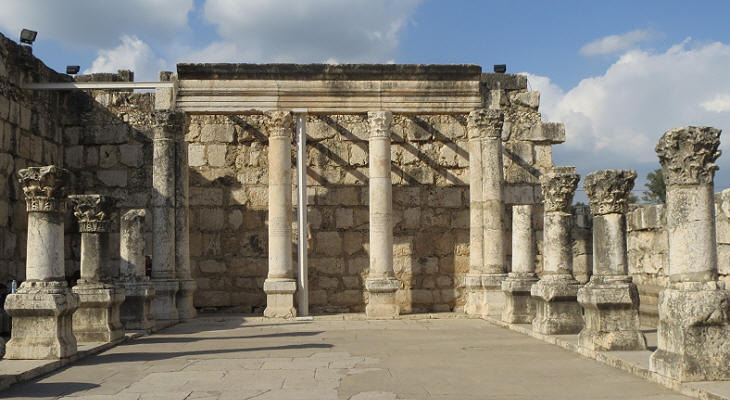
4th century synagogue, Capernaum, courtesy RomeArtLover.it
The town of Capernaum, or Kfar Nahum as it was originally called in Hebrew, was a fishing village on the northern shore of the Sea of Galilee. It was established during the time of the Judean Hasmonean dynasty in the 2nd century BCE and had a population of about 1,500.  Later, it became the home of Matthew the Evangelist, as well as Saint Peter whose house was converted into a place of worship by the early Judeo-Christians, officially becoming a church under the authority of the Byzantines.
A major archaeological site, excavations in Capernaum have revealed two ancient synagogues, one built over the other, the most recent, dating back to the 4th century. In Christian tradition, one Sabbath, while sojourning in Capernaum, Jesus healed a servant of a Roman centurion. This servant later built the first synagogue and this became the place where Jesus preached. According to the Synoptic Gospels, he selected Capernaum as the center of his public ministry in Galilee after he left the small mountainous hamlet of Nazareth (Matthew 4:12–17). Eventually though, he came to curse the town, along with Bethsaida and Chorazin, because of their lack of faith in him as the Messiah. Other healings by Jesus that occurred in Capernaum included the healing of Simon Peter's mother-in-law of a fever (Luke 4:38–39), the healing of the lepers, and the healing of the paralytic lowered by friends through the roof, as reported in Mark 2:1–12 and Luke 5:17–26. Capernaum survived the Jewish revolts against Rome in the 1st and 2nd centuries even though the Jewish historian Josephus received treatment there after suffering a battle injury nearby along the Jordan River.
By the 4th century, the local houses were constructed with good quality mortar and fine ceramics. This was about the time that the synagogue, now familiar to Israelis and tourists alike, was built. This synagogue contained a relief depicting one of the earliest representations of the Magen David (Star of David). There were some European archaeologists early in the 20th century who believed that it also contained an upper floor reserved for women, with access by means of an external staircase located in a small room. But this opinion was not substantiated by later excavations. There are two inscriptions on the site, one in Greek and the other in Aramaic, that commemorate the benefactors that helped in the construction of the building. There are also carvings of five- and six-pointed stars and of palm trees.
Capernaum remained inhabited for several centuries since its founding. It was revived after the earthquake of 749 but was later abandoned in the 11th century, shortly before the Crusader conquest. Archaeological activities at the site, as well as throughout the country, began in the early 19th century. By 1866, the British Captain Charles William Wilson identified the remains of the synagogue, and in 1894, the Franciscan Friar Giuseppe Baldi of Naples, the Custodian of the Holy Land, was able to recover a good part of the ruins from the Bedouins. The Franciscans raised a fence to protect the ruins from frequent vandalism, and planted palms and eucalyptus trees brought from Australia to create a small oasis for pilgrims. The most important excavations began in 1905 under the direction of German archaeologists Heinrich Kohl and Carl Watzinger. They were continued by Franciscan Fathers Vendelin von Benden (1905–1915) and Gaudenzio Orfali (1921–1926). The excavations resulted in the discovery of two public buildings, the synagogue and an octagonal church. In 1926, Father Orfali began the restoration of the synagogue. The work was interrupted by his death in a car accident later that year (which is commemorated by a Latin inscription carved onto one of the synagogue's columns), and was continued by Virgilio Corbo beginning in 1976. Excavations have been ongoing, with some publication on the Internet as recently as 2003.

Sunday, September 8, 2019

CAIRO

Hanging Church
The Hanging Church, courtesy, Coptic-Cairo.com
The city of Cairo is the capital of Arab-occupied Egypt. It is also the seat of its government, presently headed by President Abdel Fatah al Sisi. The indigenous Copts today, have a high regard for President al Sisi which puts to rest that all Arab Muslims are evil, which they certainly are not. Should Egypt free itself from the occupation and become a Coptic state, like Israel is a Jewish state, President al Sisi could very well find himself with an honored place in society, perhaps continue as president. Unfortunately, he is just one individual and there are many more Arabs who are evil and who try to make the lives of the indigenous Egyptians a living hell. Regarding Cairo, such incidents include, but are not limited to, the following: 2009 – a Coptic protest over a church burning resulted in an Arab Muslim mob of rage that killed 9 of the protesters and injured 150; 2011 – another mob attacks two churches. Twelve are killed and 232 injured; that same year, a peaceful protest over a church burning angered an Arab Muslim mob, including members of the military, and 27 protesters were killed, 329 injured; 2016 – a suicide bomb during a church service killed 27 and injured 49; and in 2017 – Arab gunmen opened fire on a church service killing 9 and injuring 9.
History books give the foundation year of Cairo as 972 and built by the Fatimid Arabs. This, however, is not true. Present-day Cairo was actually an outgrowth of several ancient sites in the area namely, Memphis, at one time, the capital of ancient Egypt, today hovering around Cairo’s southern border. Heliopolis also served as capital when Memphis was not. It hovers on Cairo’s northern border. In between, the ancient Egyptians erected several monuments that have stood the test of time including: the Pyramid of the Pharaoh Djoser, the Pyramids of Giza, and the Sphinx. In the 6th century BCE, the Persians built a fort settlement on the Nile and called it “Babylon” after the ancient city on the Euphrates. The Persians also built a canal from the Nile (from today’s Fustat) to the Red Sea. From that time and for many centuries afterwards, Babylon gained importance while nearby Memphis, as well as Heliopolis declined. 
In the period when Egypt was under Roman occupation, it is believed, in Christian tradition, that the Cairo area was one of the places the Holy Family visited during their flight from Judea to Egypt, and they stayed at the site that became the Church of Saints Sergius and Bacchus (today, in the neighborhood of Abu Serga). By the 4th century, as Christianity spread in Egypt, the Copts staged a revolt against Roman rule, but it was summarily crushed resulting in the Romans establishing a fortress and settlement on the site of the old Persian structures built centuries earlier. It was that fortress settlement that became the nucleus of the Cairo proper, and Coptic Cairo in particular. In the late 4th and early 5th centuries, many churches were established in the area. The Hanging Church, located on the fortress grounds and so named because it was built over the southern gate, was said to have been built during the time of the Patriarch Isaac (690-692), fifty years after the conquest of Egypt by the Arabs. Eventually, it became the official seat and residence of the Coptic Pope and remained so for the next 1200 years. Alexandria remained the historic and traditional seat until today.  
Since the Arab conquest and probably until the 8th century, the neighborhood of Fustat, the first Arab settlement in Egypt which intermittently served as capital of the local Arab occupation, was also a Coptic center. It is said that the Amr ibn al As Mosque, named after the leader of the Arab conquerors, was built in part from columns stolen from local Coptic churches.
The Moqattam area of Cairo was, according to Coptic tradition, the scene of the moving of the Moqattam Mountain. Al-Mu’izz, a Fatimid Arab caliph, asked Patriarch Abraham (reigned 975-978), the 62nd patriarch, to prove the truth of a verse in the Bible (Matthew 17:20) that he believed related to the Mountain: “Because you have so little faith. Truly I tell you, if you have faith as small as a mustard seed, you can say to this mountain, ‘Move from here to there,’ and it will move. Nothing will be impossible for you.” After three days of praying and fasting for guidance in front of a painting of the Virgin Mary, the Virgin Mary appeared to the Patriarch in a vision and instructed him on his response. When he returned to the caliph, he made the Mountain move. Al-Mu’izz was therefore convinced of the truth of the Christian faith and thereafter, allowed the Coptic Church certain privileges. However, from the 12th century onward, the Copts suffered persecution and high taxation imposed on them by the Arab authorities. This problem became so acute, that they felt forced to sell one of their churches, built in the 8th century, to the local Jewish community who thereupon built the Ben Ezra Synagogue which still stands (empty) today.
Since 1300, the Papal seat was transferred several times to different locations around Cairo: in 1300, to the Church of Saint Mercurius; in 1400, the Church of Saint Mary in Harat Zawila neighborhood; in 1660, under Pope Matthew IV, to the Church of the Virgin Mary in Harat Elroum neighborhood; in 1800, under Pope Mark VIII, to Saint Mark's Coptic Orthodox Cathedral, in Azbakeya neighborhood; and in 1971, to Saint Mark’s Cathedral in Abbassiya neighborhood where it remains today.
In 1908, after receiving approval and a number of silver antiquities from Patriarch Cyril V and raising funds by public subscription, a certain Marcus Simaika Pasha built the Coptic Museum and inaugurated it on March 14, 1910. It was a modern architectural wonder, competing with some of the local churches. Some of the most prominent churches found in and around Cairo today, aside from those mentioned above, include: Saint George and Saint Abraam, Saint Gawargious and Saint Anthony, and Saint Mark Churches, located in Heliopolis; Saint Marc, and Saint Mona Churches in Giza; Saint Mary in Masarra; Saint Mary and Saint Bishoy, and Saint Mary and Saint Rewies, in Abbassiya; Saint Mary in Zeitoon; Saint Saman el Dabagh in Moqattam; Saint Mary, Archangel Saint Mikhail, Saint Anthony, and the Martyrs Saint Philopateur and Saint Demyana Churches in Shoubra; Saint George in el Zaher; Saint Mary in Ard el Golf; Saint Marc in el Maady; The Virgin Mary in el Faggala; Saint Mary in el Matareyta; Saint George in Almaza; Saint Mary, and Saint Mina Churches in Old Cairo; Saint Barbara in el Sharabiya; Saint George and Saint Abo Sefein, and Saint Mary Churches in Central Cairo; Saint Mona in al Farag; the Holy Virgin in Babylon el Darag; Saint Menas in Fum al Khalig; and Saint Mona in Garden City.

Sunday, September 1, 2019

BYBLOS, LEBANON

byblos
Byblos, courtesy, Wikipedia

[exerpts taken from Wikipedia, curate.nd.edu, and Maronite-heritage.com]

The ancient city of Byblos, which the Arab occupation authorities refer to as “Jbeil”, is a town in Lebanon, (the ancient Phoenicia) about 26 miles north of Beirut. It is today, almost totally inhabited by indigenous Lebanese, descendants of the ancient Phoenicians, the Maronites. With a population of 40,000, it is the largest city in the Mount Lebanon region and is also considered one of the oldest continuously inhabited cities in the world. It is also said that Byblos was the first city built in Phoenicia. Beginning approximately 10,000 years ago, before the arrival of the Phoenicians in, what is now Lebanon, the town was actually known by several names. When the Phoenicians arrived, they renamed it “Gebal” and made it their first capital. A new social structure was built with each Phoenician city-state in Lebanon worshipping their own gods. The god of Gebal was known as Baalat Gebal to which, the local inhabitants built a temple. However, one of the most important local monuments of this period was the temple of Resheph, a Canaanite war god.
Gebal remained the Phoenician capital for 1500 years until it eventually moved to Tyre. From Gebal, they conducted a sea-trading empire, trading with the lands around the Mediterranean and beyond. The use of the alphabet was spread by Phoenician merchants through this maritime trade, especially into parts of North Africa and Europe. The oldest known representation of the Phoenician alphabet is inscribed on the sarcophagus of King Ahiram of Gebal, dating approximately to the 11th century BCE. 
Beginning in the 8th century BCE, Gebal was ruled by the following kings: Sibittibaal, Urumilki, Milkiasaph, and Yehowmelek who were all tributary to the invading and conquering Assyrian Empire. In 539 BCE, Phoenicia was conquered by the Persian Achaemenid Empire (538–332 BCE) and Gebal became the fourth of four Phoenician vassal kingdoms established by the Persians – the first three being SidonTyre, and Arwad. The year 332 BCE came the Greek conquest under Alexander the Great and Greek influence became widespread. Thus, the name “Gebal” was Hellenized and renamed “Byblos” (from where the word “Bible” originated). Mediterranean trade continued unhampered and coins came to be used as currency. Byblos became the import-export center of papyri – so much so that papyri was known as “Byblos material”. In addition, the temple of Resheph was elaborately rebuilt, and the city, though smaller than its neighbors, was a center for the cult of Adonis. In the 3rd century, a small but impressive theater was constructed. During the Roman period, Byblos grew rapidly. Christianity was introduced by Saint John Mark, an apostle of Jesus Christ, and Byblos became an independent bishopric. By the first and second centuries, the Phoenicians produced many scholars and academics, one of the most prominent being Philo of Byblos who wrote a detailed history of Phoenicia.
In 636, the Arab Muslims conquered Phoenicia and thus began a slow process of Arabization of the area. By 1104 however, Phoenicia fell to the Christian Crusaders with whom, the Maronites formed an alliance. Work on the Church of St. John-Mark of Byblos, later used for Maronite worship, started during the Crusader era in 1116. It was partially destroyed by an earthquake in 1176 AD. When Islamic forces captured the city a decade later, the church was transformed into a set of stables. After the final defeat of the Crusaders by the Muslim Mamluk rulers of Egypt and their conquest of the regions of the Levant, the Maronites of Byblos, like the rest of Lebanon, often came under attack by their new overlords. But in 1357, they became divided against themselves – those of the Byblos area against those of the Bsharre area just to the east. Taking advantage of the situation, the Mamluks invaded Byblos and the nearby town of Batroun in 1367, destroying these and the surrounding villages, and burning their Patriarch alive. Many people escaped to Cyprus. With the Mamluks now the clear masters of the land, and Byblos invaded by Arab settlers, the town was now more often referred to as “Jbeil”, the Arabized form of “Byblos”.

The eparchy of Jbeil was erected on June 12, 1673 and its canonical erection was confirmed in the Maronite Synod of Mount Lebanon in 1736. In 1768 it was united to the Eparchy of Batroun. Later, the Church of Saint John-Mark was given to the Maronites as a gift by the Druze Prince Youssef Chehab after they aided him in capturing the city. In 1848 the seat of the Eparchy Jbeil-Batroun became the seat of the Maronite Patriarch. After the violence in 1860 between the Maronites and the Druze, the Maronites set out on an education program, for both boys and girls. In 1863, following the orders of her superiors, Saint Rafqa, a Maronite nun, went to the School of the Monastic Order in Byblos, where she spent more than a year, teaching girls education and faith. There, she remained with success until she was transferred to another village the following year where, again, she educated the local girls in academic studies.
Since the 1920s, Byblos has been the site of several archaeological excavations. In the 60s and 70s, it was a major tourist destination, often being visited by the likes of Marlon Brando and Frank Sinatra. On June 9, 1990, the Eparchy of Jbeil-Batroun was separated and Jbeil became an independent eparchy.  
Today, despite the Maronites in Lebanon, and those of Byblos/Jbeil in particular, being under the constant watchful eye of Hizbollah and their allies, Byblos is still managing to re-emerge, with determination, as an upscale tourist hub. With its ancient portPhoenician, Roman, and Crusader ruins, sandy beaches, and surrounding picturesque mountains, as well as its fish restaurants, open-air bars, and outdoor cafes, the city makes an ideal tourist destination. Other sites include:
The Church of Saint George, the church of Mar Yacoub, the church of Saint Peter, Ain el-Malik or King’s Spring, the L-shaped Temple erected about 2700 BCE, the Temple of the Obelisks originally built between 1600–1200 BCE, the necropolis of the kings of Byblos including King Ahiram, the Roman theater built around AD 218, the Byblos Wax Museum, the Byblos Fossil Museum, the old medieval part of Byblos, and the old market.
In addition, there is an annual summer music festival that takes place in the historic quarter.