For the record, I'm neither an academic nor a scholar, and admittedly, I've never been to many of the places posted here. So if someone should find a mistake, or believe I omitted something, please feel free to email me and I'll correct it.

I can be contacted at dms2_@hotmail.com.

Monday, May 17, 2021

SYRIA

Landscape of the plains of Syria Stock Photo - 92243372
view of Syria, courtesy, 123rf.com
The history of Syria goes back thousands of years to the Aramean tribes that roamed the steppes of the area that was called “Aram-Dimashq”. This area later became part of the Assyrian Empire, the Babylonian Empire, and the Persian Achaemenid Empire, and then controlled from Damascus by the Greek Seleucid Empire, part of the empire established by Alexander the Great. Later, it passed into the hands of the Persian Parthians, then the Romans, and finally the Byzantines until conquered and occupied by the Arabs, in which state, the country remains to this day. Today, the Arab Republic of Syria is an Arab-occupied country. The indigenous descendants of the ancient Arameans are Christians, followers of the Syriac Orthodox Church. Being non-Arabs, they are at the mercy of the Arab occupation authorities. This was true before, during, and after the Arab civil war.

The Syriac Orthodox Church is not to be confused with the Assyrian Church of the East. Both these churches have their own autonomous leaderships but both are also very much related to one another especially since services in both churches are done in the Aramaic vernacular. The patriarch of the Syriac Orthodox Church, like the patriarchs of several other churches, had their seat originally in the city of Antioch, today occupied by Turkey. Later on, the patriarchal seat made its way to Damascus. Both the church and the patriarchal seat were established by Saint Peter in the 1st century AD, but split into two separate lines of patriarchs after the deposition of Severus of Antioch in 518 over the issue of the Council of Chalcedon of 451.

The following is a chronological list of the patriarchs of the indigenous Syriac Orthodox Church:

1.     Apostle Peter (c. 44–c. 53)

2.     Evodius (c. 53–c. 69)

3.     Ignatius (c. 70–c. 108), who was martyred in the reign of Roman Emperor Trajan. His seven epistles are unique sources for the early Church.

4.     Herodion (107–127)

5.     Cornelius (127–154)

6.     Eros of Antioch (154–169)

7.     Theophilus (c. 169–c. 182)

8.     Maximus I of Antioch (182–191)

9.     Serapion (191–211)

10. Asclepiades the Confessor (211–220)

11. Philetus (220–231)

12. Zebinnus (231–237)

13. Babylas the Martyr (237–c. 250), who, according to Nicephorus, was martyred in the reign of Roman Emperor Decius.

14. Fabius (253–256)

15. Demetrius (256–260), who was taken captive by the Persians under Shapur

16. Paul of Samosata (260–268) supported by the Palmyra Empress Zenobia, deposed by Roman Emperor Aurelian.

17. Domnus I (268/9–273/4), supported by Aurelian

18. Timaeus (273/4–282)

19. Cyril I (283–303)

20. Tyrannion (304–314)

21. Vitalius (314–320)

22. Philogonius (320–323)

23.  Eustathius (324–330). In 325, the 6th canon of the First Ecumenical Council granted to Antioch the jurisdiction over all the provinces of the East.

24.  Paulinus I (330, six months), formerly bishop of Tyre, a Semi-Arian follower of the Christian dogma of Arianism, and friend of Eusebius of Caesarea

25.  Eulalius (331–332)

26.  Euphronius (332–333)

27.  Facellius (333–342), in whose time, construction of the Great Church of Antioch was complete (341). It acted as the seat of the Syriac Orthodox Church for the next 250 years.

28.  Stephanus I of Antioch (342–344), Arian and opponent of Coptic (Egyptian) Patriarch Athanasius of Alexandria, deposed in 344.

29.  Leontius the Eunuch (344–358), Arian

30.  Eudoxius (358–359), formerly bishop of Germanicia, later (360–370) bishop of Constantinople, follower of the Arian Christian sect of Homoians

31.  Anianus (359), immediately deposed

32.  Meletius (360/1–381), during his reign, the followers of Eustathius, strictly adhering to the Nicene creed, elected their own bishops until 393 starting a schism in the church. They were recognized by the bishops of Alexandria and Rome. Meletius was deposed during the reign of Roman Emperor Valens for Homoiousian Christian leanings.

This deposition resulted in the Meletian Schism, which saw several groups and several claimants to the see of Antioch. The largest grouping, centered on Meletius. It moved towards an acceptance of the Nicene creed and participated in the Council of Constantinople, but was not recognized by Alexandria or Rome. Meletius was succeeded by:

·         Flavian I (381–404), who obtained the recognition of Alexandria and Rome in 399

·         Porphyrus (404–412)

Alexander (412–417), ended the schism with the Eustathians in 415

·         Theodotus (417–428) (alternately 420–429)

·         John I (428–442), condemned the First Council of Ephesus in the Nestorian controversy

·         Domnus II (442–449), deposed by the Second Council of Ephesus.

·         Maximus II (449–455), appointed by Byzantine Emperor Theodosius II, accepted the Council of Chalcedon, deposed under unclear circumstances.

·         Basil of Antioch (456–458), Chalcedonian

·         Acacius of Antioch (458–461), Chalcedonian

·         Martyrius (461–469), Chalcedonian, deposed by Byzantine general, later Emperor, Zeno

·         Peter the Fuller (469/470–471), Non-Chalcedonian, appointed by Zeno, deposed by Byzantine Emperor Leo I

·         Julian I (471–476), Chalcedonian, exiled by Peter the Fuller

·         Peter the Fuller (476), restored by usurper Basiliscus, exiled by Zeno

·         John II Codonatus (476–477), Non-Chalcedonian, who held the see only three months and was exiled

·         Stephen II of Antioch (477–479), Chalcedonian

·         Calendion (479–485), Chalcedonian, opposed the Henoticon church document, exiled by Zeno, replaced by Peter the Fuller

·         Peter the Fuller (485–488), restored by Zeno and condemned the same year (485) by a synod at Rome

·         Palladius (488–498), Chalcedonian, accepted the Henoticon,

·         Flavian II (498–512), Chalcedonian, accepted the Henoticon, deposed by Byzantine Emperor Anastasius I.

·         Severus (512–518), Non-Chalcedonian, appointed by Emperor Anatasius I, deposed and exiled by Emperor Justin I. Since then, the seat of the Syriac Orthodox Patriarch of Antioch moved to different monasteries including Qartmin, Qenneshrin (Chalkis, near Aleppo), Malatya, and Amid (Diyarbakir).

·         Paul the Jew (518–521), Chalcedonian

·         Euphrasius (521–528), Chalcedonian

·         Ephrem of Amid (528–546), Chalcedonian. The Syriac non-Chalcedonians recognized Severus as the legitimate Patriarch until his death in 538. In 544, non-Chalcedonian leader Jacob Baradaeus consecrated:

·         Sergius of Tella as bishop of Antioch, opening the lasting schism between the Greek Orthodox Church of Antioch, part of the Eastern Orthodox Church, and the Syriac Orthodox Church, part of Oriental Orthodoxy. Sergius of Tella was succeeded by:

  1. Paul II (c. 551/564–578)

vacant (578–581)

  1. Peter III (578/581–591)
  2. Julian II (591–594)

vacant (594-603)

  1. Athanasius I Gammolo (594/595/603–631)
  2. John III (631–648)
  3. Theodore (649–666/667)
  4. Severus II bar Masqeh (667/668–680/684)

vacant (680–684)

  1. Athanasius II Baldoyo (683/684–687)
  2. Julian III (687–707/708)
  3. Elias I (709–723/724)
  4. Athanasius III (724–739/740)
  5. Iwannis I (739/740–754/755)

Isaac I (755–756)

Athanasius Sandalaya (756–758)

  1. George I (758/759–789/790)

John of Raqqa (758–762)

David of Dara (762–774)

  1. Joseph (790–791/792)
  2. Quriaqos of Tagrit (793–817)

Abraham (807/808–837)

  1. Dionysius I Telmaharoyo (818–845)

Simeon (c. 837)

  1. John IV (846/847–873/874)

vacant (874–878)

  1. Ignatius II (878–883)

vacant (883–887)

  1. Theodosius Romanus (887–896)

vacant (896–897)

  1. Dionysius II (896/897–908/909)
  2. John V (910–922)
  3. Basil I (923–935)
  4. John VI (936–953)
  5. Iwannis II (954–957)
  6. Dionysius III (958–961)
  7. Abraham I (962–963)

vacant (963–965)

  1. John VII Sarigta (965–985)
  2. Athanasius IV Salhoyo (986/987–1002/1003)
  3. John VIII bar Abdoun (1004–1030/1031/1033)
  4. Dionysius IV Yahyo (1031–1042)

vacant (1042–1049)

  1. John IX bar ʿAbdun (1042/1048/1049–1057)
  2. Athanasius V Yahyo (1057/1058–1062/1064)
  3. John X bar Shushan (1063/1064–1072/1073)
  4. Basil II (1074–1075)

John bar ʿAbdun (1075–1076/1077)

  1. Dionysius V Lazarus (1077–1078/1079)

vacant (1078/1079–86)

  1. Iwannis III (1086–1087/1088)
  2. Dionysius VI (1088–1090)
  3. Athanasius VI bar Khamoro (1090/1091–1129)
  4. John XI bar Mawdyono (1129/1130–1137)
  5. Athanasius VII bar Qatra (1138/1139–1166) under whose reign, the patriarchal seat was transferred to the Dayro d’Mor Hananyo Monastery in the town of Mardin, today in southeastern Turkey near the Syrian border.
  6. Michael I (1166–1199)

Theodore bar Wahbun (1180–1193)

  1. Athanasius VIII bar Salibi (1199–1207)

Michael II the Younger (1199/1200–1215)

  1. John XII (1207/1208–1219/1220)

vacant (1220–1222)

  1. Ignatius III David (1222–1252)

Dionysius VII ʿAngur (1252–1261)

  1. John XIII bar Ma'dani (1252–1263)
  2. Ignatius IV Yeshu (1264–1282/1283)

83.  Philoxenus I Nemrud (1283–1292), upon his death, the Syriac Orthodox Church split into the patriarchates of Antioch, Mardin, and Melitene.

  1. Michael II (1292–1312)

85. Michael III Yeshu (1313–1349)

86. Basil III Gabriel (1349–1387)  The patriarchate of Melitene ended in c. 1360. A separate patriarchate of Tur Abdin broke off from the patriarchate of Mardin in 1364.

87. Philoxenus II (1387–c. 1421)

88.  Basil IV Simon (1421/1422–1444/1445)

89.  Ignatius Behnam Hadloyo (1445-1455)

90.  Ignatius Khalaf Maʿdnoyo (1455/1456–84)

91. Ignatius John XIV (1484–1493)

92. Ignatius Noah of Lebanon (1493/1494–1509)

93. Ignatius Yeshu I (1509–1510/1519)

  1. Ignatius Jacob I (1510/1512–1517/1519); Athanasius bar Subay appointed as rival patriarch (1511–between 1514 and 1518)

95. Ignatius David I (1519–1521)

96. Ignatius Abdullah I (1521–1557)

97. Ignatius Nimat Allah (1557–1576)

98. Ignatius David II Shah (1576–1591)

99. Ignatius Pilate (1591–1597)

100.                     Ignatius Hidayat Allah (1597/1598–1639/1640)

  1. Ignatius Simon (1640–1653); Ignatius Shukrallah I appointed as rival patriarch (1640–1670)

102.                     Ignatius Yeshu II (1653/1655–1661)

103.                     Ignatius Abdulmasih I (1661/1662–1686)

104.                     Ignatius George II (1687–1708)

105.                     Ignatius Isaac II (1709–1722)

106.                     Ignatius Shukrallah II (1722/1723–1745)

107.                     Ignatius George III (1745/1746–1768)

108.                     Ignatius George IV (1768–1781)

109.                      Ignatius Matthew (1782–1817/1819). Catholicism was introduced in 1783.

110.                     Ignatius John (1817–1818)

111.                     Ignatius George V (1819–1836/1839)

112.                     Ignatius Elias II (1836/1839–1847)

113.                     Ignatius Jacob II (1847–1871)

114.                     Ignatius Peter IV (1872–1894)

115.                     Ignatius Abdulmasih II (1894/1895–1903)

116.                     Ignatius Abdullah II (1906–1915)

vacant (1915–1917)

117.                     Ignatius Elias III (1917–1932/1933)

118.                     Ignatius Aphrem I (1933–1957); patriarchal seat moved to Homs.

119.                     Ignatius Jacob III (1957–1980); patriarchal seat moved to the Cathedral of Saint George in the district of Bab Touma in Damascus.

120.                     Ignatius Zakka I (1980–2014)

121.                     Ignatius Aphrem II (2014–present)

Tuesday, May 11, 2021

SAFED

view of Safed, courtesy, Chabad.org
Safed is a city in the Northern District of Israel. Located at an elevation of roughly 2,953 feet, Safed is the highest city in the Galilee and in Israel. In 2019 it had a population of 36,094.

Although not mentioned in the Bible, during the time of Joshua, the site of Safed was allotted to the Israelite tribe of Naphtali. It became the burial place of both, the Prophet Hosea, the monument of which, was said to have been built by the Karaite Jews of Damascus in the fifteenth century, and Benaiah ben Joiadah a commander in the army of King David. It has been suggested that Jesus' statement "a city that is set on a hill cannot be hidden" may have referred to Safed. According to historians and archaeologists, Safed was identified with Sepph, a fortified town in the Upper Galilee mentioned in the writings of the Jewish historian Josephus during the Judean wars against Rome. The Jerusalem Talmud mentions Safed as one of five elevated spots where fires were lit to announce the New Moon and festivals during the Second Temple period. During the Talmudic period, many scholars resided in the town, namely Yosi ben Yokrat whose burial place became one of the major sites of pilgrimage. Two liturgical poems for the Ninth of Av by Eleazar KallirEikhah Yashevah and Zekhor Eikhah, refer to Safed as a place where the priestly families Jakim and Pashhur settled after the destruction of the Temple. Jews still lived in Safed in the first half of the 11th century as attested by documents in the Cairo Genizah. One document composed in 1034, mentions a transaction made in Tiberias several years before by a certain Jew, Musa ben Hiba ben Salmun "al-Safati" (of Safed). Benjamin of Tudela, who visited the city in 1170/71, stated that no Jews lived there. But Samuel ben Samson, who visited the town in 1210, mentions the existence of a Jewish community of at least fifty. He also noted that two Muslims guarded and maintained the cave tomb of Rabbi Hanina ben Horqano. By the 1220s, a community was definitely revived under Mamluk protection; R. Zadok, head of an academy of the gaon Jacob, was its most prominent member. In 1289 Moses b. Judah ha-Kohen, chief rabbi of Safed, accompanied by his assessors, went to Tiberias, and pronounced over the tomb of Maimonides an anathema on all who should condemn his writings. In 1481 the Jewish community of Safed and of the villages in its vicinity flourished under the protection of the Mamluk governors. Ten years later, Perez Colombo became Safed’s Chief Rabbi. He was so poorly paid that he was obliged to carry on a grocery business; but in the following year the community was reorganized by Joseph Saragossi who had arrived from Spain. That same year, the community was greatly strengthened by an influx of Jewish refugees from Spain. The Spanish Jews built a number of synagogues in the town, one of which, was named after Isaac Aboab, "the last gaon of Castile". It housed the "Sefer Aboab" Torah scroll that was attributed to him. In 1495 the Jews of Safed were reported as trading in spices, cheese, oil, vegetables, and fruits.  

In 1516/17, the Ottoman Empire conquered the whole of the Land of Israel. Due to rumors that Selim, the Ottoman Sultan, was slain by the Mamluks, a local Arab revolt broke out against the newly-appointed Ottoman governor, which resulted in wide-scale killings, many of which targeted the city's Jews, who were viewed as sympathizers of the Ottomans. But after stability was reestablished, Safed experienced a new era of growth and prosperity. Jews established looms for wool and textile production, whose products competed with those of Venice. In addition the Jews of Safed traded in the local produce of Galilee: honey, silk, and spices – this in addition to the traditional products traded under the Mamluks (as mentioned above). They also received both Jewish and gentile pilgrims in their homes. Safed became known as one of the Four Holy Cities of Judaism. In 1522 R. Moses Basola found 300 Jewish families in Safed, composed of many communities. The Jewish quarters were all situated west of the fortress. Each quarter was named for the place of origin of its inhabitants: Purtuqal (Portugal), Qurtubah (Cordoba), Qastiliyah (Castille), Magharibah (northwestern Africa), Araghun wa'Qatalan (Aragon and Catalonia), Majar (Hungary), Puliah (Apulia), Qalabriyah (Calabria), Sibiliyah (Seville), Taliyan (Italian), Alaman (German), and Musta'rib (the indigenous Palestinians). There was also a Samaritan community (also indigenous Palestinians). Among the prominent leaders of the community in this period were R. Jacob (i) Berab, who tried to reestablish the Sanhedrin and renew rabbinical ordination (semikhah), R. Joseph Caro, the author of the Shulḥan Arukh, his contemporary R. Moses Trani, the Kabbalist Rabbi Moshe Cordovero, and Shlomo Halevi Alkabetz, composer of the Sabbath hymn "Lecha Dodi". From their teachings, Safed became the center of Jewish mysticism, the Kabbalah. The leading kabbalist R. Isaac Luria lived in Safed and his important disciple R. Ḥayyim Vital resided there for some time. The mikveh and synagogue of Isaac Luria still exists. In 1563 the brothers Ashkenazi who came from Poland, set up the first printing press in the town; it was not only the first one in the Land of Israel but also the first in the Orient outside of Turkey. The fortunes of the Safed Jews began to change for the worst about a decade later. There were more than 7,000 Jewish families in Safed in 1576 when Sultan Murad III issued an edict for the forced deportation of 1,000 wealthy families among the Jews to Cyprus to boost the island's economy. There is no evidence that the edict, or a second one issued the following year for the removal of 500 families, was enforced. With the gradual decline in the quality of Turkish rule in the 17th century, the prosperity of the Jewish community also began to decline. The material decline did not immediately influence the spiritual level of the community. In spite of high taxes and 1,200 poor living on charity, there were 300 rabbinical scholars, 18 schools, 21 synagogues and a large yeshivah with 100 pupils, and 20 teachers. In c. 1625, the orientalist Quaresmius spoke of Safed being inhabited "chiefly by Hebrews, who had their synagogues and schools, and for whose sustenance contributions were made by the Jews in other parts of the world." The Safed Jews had suffered from raids and plundering by the Druze under Mulhim ibn Yunus, nephew of Fakhr al-Din as a consequence of the wars breaking out in the Lebanon between the Druze and Ottoman forces. The majority of Jews fled the town. Five years later, Fakhr al-Din was routed by the Ottoman governor of Damascus, Mulhim abandoned Safed, and some of its Jewish residents returned. But in 1656, the Druze again attacked the Jews of Safed as a consequence of power struggles between the heirs of Fakhr al-Din which included Mulhim. In 1660, in the turmoil following the death of Mulhim, the Druze destroyed Safed with only a few of the former Jewish residents returning to the city by 1662. Toward the end of the century the community declined rapidly – in 1695/96 only 20 Jews paid the poll tax. An epidemic decimated the community in 1747 and an earthquake in 1759 killed 190 Jews. After the disaster the survivors began to leave the town; by 1764 there were only 50 Sephardi families in Safed. But in 1776 Safed Jewry increased due to the arrival of Jews from the Russian Empire, and five years later two Russian rabbis, Löb Santower and Uriah of Wilna, brought there a number of families from Volhynia, Podolia, and the Ukraine, the consuls of Russia and Austria taking these Jews under their protection. In 1778 over 300 Ḥasidim, disciples of R. Israel b. Eliezer Ba'al Shem Tov, settled in Safed; they were led by R. Menahem Mendel of Vitebsk. The disciples of Elijah, the Gaon of Vilna, who were opponents of the Ḥasidim, came in 1810, led by R. Israel b. Samuel of Shklov.

Warfare among Bedouin tribes and epidemics in 1812–14, caused another exodus of Jews, mainly to Jerusalem and the villages in Galilee. In 1820, following Acre Governor Abdullah Pasha's order to kill his Jewish vizier Haim Farhi, who had previously served under Ahmed al Jazzar and Sulayman, many of the Safed Jews were promptly imprisoned being accused of tax evasion under the concealment of Farhi; they were released upon payment of a ransom. The resulting war (1822-23) between Abdullah Pasha and the influential brothers of Farhi residing in Constantinople and Damascus, prompted Jewish flight from Safed and the Galilee in general. The Egyptian forces of Muhammad Ali wrested control of the Levant from the Ottomans in 1831 and in the same year many Jews who had fled the Galilee, including Safed, returned as a result of Muhammad Ali's liberal policies toward Jews. In 1832 the printer Israel Bak of Berdichev settled in Safed and established a printing and publishing business. In 1833, at the approach of Ibrahim Pasha, the Jewish quarter was plundered by the Druze tribesmen. Many escaped to the suburbs. The following year it was again pillaged, this time by Arabs, the persecution lasting thirty-three days, and causing damage estimated to be about 135,250 piasters. However, when Ibrahim Pasha returned, he imposed an indemnity on the surrounding villages, and repaid the Jews 7 per cent of their losses. On Jan. 1, 1837, more than 4,000 Jews were killed by an earthquake, the greater number of them being buried alive in their dwellings. Since the earthquake, the fortunes of Safed actually took a turn for the better. The city’s houses and synagogues were rebuilt by Sir Moses Montefiore, who visited the city seven times between 1837 and 1875, and by the philanthropist and community activist Isaac Vita of Trieste. Foreign diplomatic missions were established in the city and the Jewish Abu family acted as consular agents of France whose position was hereditary. In 1847, in spite of the plague raging again in the holy city, the country's administration stabilized under the Turkish sultan ʿAbdul Majīd. Some of the former Jewish inhabitants returned and new immigrants arrived from Persia, Morocco, and Algeria. In 1864, the printing industry was reestablished by Israel Dov Beer and by 1895, for the first time in 300 years, the Jews formed a majority of the city’s population. At the end of the century Rabbi Meyer Taubenhaus founded a weaving shop to provide employment for Jewish workers, and also opened a soup kitchen for the poor. The first Jewish kindergarten was opened on his initiative in 1906 with the support of B'nai B'rith; in 1910 it was enlarged to become a modern elementary school.

By 1905, Isaac Abu acted as consular agent of France while Avraham Cohen Ajami was consular agent of Persia. The initiative for the changeover to productive work influenced groups of Jews from Safed to attempt agricultural settlement at Gei Oni (later Rosh Pinnah) and at Benei Yehudah on the Golan. Workshops, mostly for local consumption (e.g., bakeries), were opened in the Jewish quarter, but the majority of the community remained dependent on ḥalukkah. In 1913 Barukh Barzel and his partners opened a Hebrew press called "Defus ha-Galil" with some 20 books being printed up to 1926.

During World War I the Safed community was cut off from its sources of support in Europe, and its Jewish population was decimated by hunger and disease. When the Ottomans were defeated by the British at the end of the war, Safed came under British rule. In 1929, the city’s Arab population, instigated by the nationalists, assaulted the Jewish quarter and killed several of the inhabitants resulting in some of the Jewish neighborhoods being ethnically cleansed. The situation stagnated thereafter. Safed was included in the part of Palestine allocated for the proposed Jewish state under the United Nations Partition Plan for Palestine. By the time of Israel's War of Independence (1948), less than 2,000 of the city’s 12,000 inhabitants were Jews, living in the narrow quarter on the northern and northwestern slope of Safed Hill. When the British evacuated the town, they permitted Arab forces (estimated at 4,000–4,500 men, including detachments of the Iraqi and Lebanese armies) to occupy the two large police buildings in key positions, thereby sealing off the Jewish quarter. On May 1, 1948, a Palmaḥ force, the Yiftach Brigade, stationed at the local “Bussel House”, advanced from positions on Mount Canaan and Biriyyah, occupied the Arab villages of Biriyyah and Ein Zeitun, and from there entered the Jewish quarter by hidden paths, bringing the number of its defenders from about 60 to 222. On May 10–11, 1948, the defenders launched attacks on the Arab positions and captured them as well as the Meẓudah ("fortress") on top of Safed Hill. The entire Arab population and armed forces fled. After the war, mainly new immigrants from different countries settled in Safed. The town's economy was based principally on branches of tourism, recreation, and industry. In the 1950s and 1960s, Safed was known as Israel's art capital. An artists' colony became a hub of creativity that drew artists from around the country, among them Yitzhak FrenkelYosl BergnerMoshe Castel, Menachem Shemi, Shimshon Holzman and Rolly Sheffer. In honor of the opening of the Glitzenstein Art Museum in 1953, the artist Mane Katz donated eight of his paintings to the city. In the 1960s, Safed was home to the country's top nightclubs, hosting the debut performances of Naomi ShemerAris San, and other singers. Nowadays, Safed has been hailed as the klezmer capital of the world, hosting an annual Klezmer Festival that attracts top musicians from around the globe. During the 1990s and early 2000s, the town accepted thousands of Russian and Ethiopian Jewish immigrants. 

Unfortunately, Safed has not escaped Arab terrorism over the years. In 1974, 25 Israeli Jews (mainly school children) from Safed, were killed in the Ma'alot massacre committed by Arab terrorists. In July 2006, "Katyusha" rockets fired by Hezbollah from Southern Lebanon hit Safed, killing one man and injuring others. Many residents fled the town. 

Beginning in the 1980s, Safed saw important developments in the field of education. The Livnot U'Lehibanot program, established in 1980, provides an open, non-denominational atmosphere for young Jewish adults that combines volunteering, hiking and study with exploring Jewish heritage. Sharei Bina is a program for women who have just finished high school and want to study in a seminary in Safed for one year learning Jewish spirituality, the shekhinah, and other Kabbalistic rituals. Beginning in 2011, the Safed Academic College began a program designed specifically for Haredi (ultra-Orthodox) Judaism with separate classes for male and female students. This would allow haredi women living in the Upper Galilee access to higher education, while still maintaining strict religious practice.  In October 2011, Israel's fifth medical school opened in Safed, housed in a renovated historic building in the center of town that was once a branch of Hadassah Hospital. The Azrieli Faculty of Medicine, opened as an extension of Bar-Ilan University, was created to train physicians in the Upper Galilee region. 

Other sites in Safed include: several museums and galleries that function in the historic homes of major Israeli artists such as the Frenkel Frenel Museum, Beit Castel gallery, Beit Hameiri museum documenting Safed's Jewish community over the past 200 years, and the Museum of the Art of Printing displaying the first Hebrew printing press. Safed still contains several old synagogues (aside from Isaac Luria’s synagogue and that of Aboab), all of which, were rebuilt after the 1837 earthquake. Among them are: a smaller synagogue of Luria which belongs to the Ashkenazim, the Synagogue of Rabbi Yossi haBannai, and the Synagogue of Rabbi Yosef Caro. The Ashkenazim also have a library containing a large collection of modern Hebrew works, while the Sephardic Jews possess two public libraries well supplied with rabbinical works, as well as a private library named after Ḥayyim Sethon.

Sunday, May 2, 2021

ROSH PINA

a view of Old Rosh Pina, courtesy, Wikpedia (Hebrew)

Rosh Pina is an Israeli town and local council in the Korazim Plateau in the Upper Galilee. It is situated on the eastern slopes of Mount Kna'an in the Northern District, roughly 5 miles north of the Sea of Galilee near the city of Safed. In 2019 it had a population of 3,148.

In Biblical times, the site of Rosh Pina was allotted to the Israelite tribe of Naphtali. Centuries later, during the Greek or Roman periods, a synagogue was built for the local inhabitants but it, as well as the rest of the town, was later abandoned, probably during the Byzantine period. Some time after the invasion of the Arabian caliph in the 7th century, various Arab tribes arrived in the area and settled there. The site of Rosh Pina was then established as the Arab village of al-Jauna. Beginning in 1878, Jews began to return to the area. In 1878, al-Jauna sold half its lands, about 2,500 dunum, to a group of native-born Jews from Safed led by Elazar Rokah. Settling in the newly-purchased lands, they called their settlement Gei Oni ("Valley of my Strength") as a Hebrew adaptation of the Arabic name. They fostered friendly relations with their Arab neighbors and often allied with them when fighting off Bedouin raids. After one year of good harvests, a year of drought saw the Arabs mortgage their lands to money lenders, but the Jews were unwilling to do the same and left. In 1882, the settlement was renewed as a moshavah by immigrants from Romania, who named it Rosh Pina ("cornerstone") after Psalm 118:22: "The stone which the builders rejected has become the cornerstone". A House of Dignitaries was built as a center of administration and finance for Rosh Pina as well as for other towns in the Galilee region. From this building, a loudspeaker was used to broadcast the local news. In 1883, the town became the first to come under the patronage of the Baron Edmond James de Rothschild. Rothschild's agent Joshua Ossovetski expanded the settlement with not only more land from al-Jauna but also from Safed. Eventually, about half a million grape-vines, and about 20,000 mulberry-trees would be planted. Rothschild's gardens were established in 1886, designed by a French landscape architect, with many plants such as Bougainvilleas and pine trees that were brought from France. Laurence Oliphant, a Christian Zionist and mystic from Britain, had visited Rosh Pina and later collected funds for the village from Christadelphians and other sympathizers in Britain. Good relations between Rosh Pina and al-Jauna had continued to persist over the years and in 1899, a modern Arab school was built in al-Jauna, courtesy of the people of Rosh Pina. Botanist Aaron Aaronsohn, while trekking around Rosh Pina during his 1906 field trip, discovered wild-growing emmer wheat, which was discovered to be the ancestor of most of today’s wheat grains. This was an important find for agronomists and historians of human civilization. The Mer house became the home of Professor Gideon Mer, a Lithuanian Jew who had settled in Rosh Pina in 1914. An expert on malaria and epidemiology, he was an important contributor to the eradication of malaria in the 1930s.

During the War in Independence in 1948, Rosh Pina became the location of Camp Philo of the Yiftach Brigade, a unit of the Palmach, later absorbed into the Israeli Defense Forces.

Today, some of the local sites include: Ben Ya'akov Airport located 1 mile from the town; the Mifne Center, a program for the treatment of autism spectrum disorder; Mitzpe HaYamim, a world-class spa; PICA (Palestine Jewish Colonization Association) House, originally an administrative center and residence for Baron de Rothschild’s clerks, advisors, and agricultural counselors, today, provides an audio-visual presentation of the story of Rosh Pina; the Pioneers National Restoration Site in old Rosh Pina; and the old silk factory.

Sunday, April 25, 2021

RISHON LEZION

Rishon LeZion, Israel, courtesy, Onward Israel
Rishon LeZion is a city in Israel, located along the central coastal plain, roughly 5 miles south of Jaffa. It is part of the Gush Dan metropolitan area. As of 2017, it was the fourth-largest city in Israel, with a population of 254,384.

In the time of Joshua, the village of En haKoreh (mentioned in Judges 15:19) was allotted to the tribe of Dan. Abandoned after the Roman destruction of Judea in 135, it wasn’t until many centuries later, after the Arab conquest of the region in the 7th century, that a small group of Arab settlers took over the area and Arabized its name to Ayun Kara. But by 1882, mainly Russian, Jews began to return to the area. The British vice consul in Jaffa Haim Amzaleg, a native-born Jew from Jerusalem, purchased 835 acres of land from Ayun Kara under their Mukhtar, Mustafa Abdallah ali Dajan. This community was the second modern Jewish farm settlement established after Petah Tikva, and the first by the early Zionists. They therefore called their community “Rishon LeZion”, derived from a biblical verse: "First to Zion (Heb. Rishon LeZion רִאשׁוֹן ןלְצִיּוֹ) are they, and I shall give herald to Jerusalem" (Isaiah 41:27).  

In the beginning, there were problems posed by sandy soil and the pioneers’ lack of agricultural experience. But probably a more important problem was lack of water. Baron Edmond de Rothschild, who had financially supported this and other communities throughout Israel, brought in water experts who then drilled for water in strategic locations. He also brought in agronomists and administrators who immediately established a local administrative office (now a soldiers’ memorial). They introduced fruit growing, especially wine grapes from the vine strains sent from southern France. But a crisis arose when the administrators regarded the settlers as hired workers and stifled their initiative. The vine strains proved unsuitable and the grapes had no market. The farmers’ revolt in 1884 changed all that. Part of the vineyards were then replaced by almond plantations.

In 1883 Itzhak Leib Toporovski a local blacksmith created the first iron plow in the land of Israel, and in 1885 the flag that would later become the flag of Israel was raised for the first time as part of the celebrations of the 3rd anniversary of the village. The Great Synagogue, which became a major focus of life in Rishon LeZion, was built between 1885 and 1889. Under Rothschild's patronage, the Carmel-Mizrahi Winery was established in 1886. That same year, the Haviv elementary school was founded as the first modern school to teach exclusively in Hebrew. Naphtali Herz Imber, the famed Hebrew-language poet, lived in Rishon LeZion for a few years in the late 1880s. He was the author a poem entitled “Tikvatenu”. In 1887, Shmuel Cohen, a young resident of Rishon with a musical background, observed the emotional response of the local Jewish farmers to Tikvatenu. Using his musical skills, he put the poem to a musical adaptation of a Moldavian/Romanian folk-song, "Carcul cu Boi" (the Cart with Oxen), and it was later retitled as “Hatikvah”, Israel’s national anthem. In 1895, the Rishon LeZion orchestra was established, and that was followed three years later by the world’s first Hebrew kindergarten, founded by Esther (Shapira) Ginzburg a former student of the Haviv school.

By 1900, the chief commodities of the community would be wine and brandy, which were then exported mainly to Egypt, Constantinople, Russia, Germany, and the United States. Over a million and a half vines had been planted, most of which, were imported from the United States and grafted with French varieties. Over 20,000 mulberry-trees, used in silkworm culture, as well as a large number of fruit-trees, such as the almond, fig, pomegranate, apple, and citron, thrived.

In 1900 the management of the village was transferred from the Baron de Rothschild’s office to the village council and the Jewish Colonization Association. In 1910 the village bell was constructed next to the medicine house. Immigration from Eastern Europe and Yemen brought additional Jewish laborers. Thousands of additional citrus groves of grapes and other fruits were planted and the village progressed economically. In 1912 the village’s first car made its appearance.

During World War I the Turkish governor Djemal Pasha, in appreciation of the village's achievements in reclaiming formerly barren terrain, ordered an area of 5,000 acres (20,000 dunams) of sand dunes stretching from Rishon leZion west to the seashore to be annexed to its boundaries. In 1916, the village, as well as the rest of the country, experienced a Locust attack. On November 14, 1917, Ayun Kara was the scene of a bloody battle between Turkish and New Zealand troops and the local Arabs would often carry the wounded to a medical facility in Rishon LeZion. In the wake of the battle, the New Zealanders set up a local military camp. Relations between the troops and villagers were good, and the troops brought the villagers the news of the Balfour Declaration

In 1919 after the war, the women of Rishon LeZion were given voting rights and in the same year Nehama Pohatchevsky was elected chairman of the village council which marked the first time a woman was elected to the position. By 1924, Rishon LeZion was connected to the regional electrical grid.  In 1939, the Rishon LeZion Chess Club was founded and today, it is one of the leading clubs in Israel, in senior, women and youth leagues. (World champion Garry Kasparov was a former member.) The Hapoel Rishon LeZion football club appeared in two cup finals, in 1946 and in 1996 and won the 2012–13 Toto Cup Leumit. Maccabi Rishon Lezion played at the top division during the 1940s and the two seasons after the Israeli Declaration of Independence. Rishon LeZion was declared a city in 1950, by which time it had a population of around 18,000. During the Gulf War in 1991, the mayor of Münster, Germany, made a surprise visit. According to Haaretz, he felt he could not sit quietly at home while missiles were falling on his sister city. Throughout the war, he stayed at the home of Rishon LeZion mayor Meir Nitzan and accompanied him on visits to sites hit by missiles. In 2007, the Rishon LeZion Municipality was awarded the Ministry of Interior Prize for Proper Management. By 2020, the city’s population was over 253,000. 

Today, Rishon LeZion's main industries are wineconstructionservices and commerce. Factories and workshops are located in the old industrial zone, which has become a popular venue for pubs, dance clubs, and restaurants. The other industrial zone is called Mabat, an abbreviation for Miskhar, Bilui VeTa'asiya (Commerce, Pastime and Industry). It is located in the west of the city. Most of the residents find work in and around Tel Aviv settlement and as a result, Rishon has become one of Israel’s most congested cities.

The old city of Rishon contains the original neighborhoods, some buildings dating back to its founding in 1882. This quarter is located in the city center, between and around Herzl and Jabotinsky Streets. It includes the neighborhoods of Nahalat Yehuda, Neve Hillel, Bnot Hayil, Abramovich, Katzenelson, Remez (Giv'at Levinson), and Rishonim (Gan Nahum). Other local sites include: Rothschild Center shopping mall, Gold Mall (Kenyon HaZahav), the newly constructed Azrieli Rishonim shopping mall, Shafdan recycling plant, the municipal zoo, Superland amusement park, a beach promenade, Heychal HaTarbut (Hall of Culture), a boardwalk (Tayelet Hatnei Pras Nobel) in honor of Jewish Nobel Prize winners, the history museum, the Well, and the old water tower. Active football teams, aside from those mentioned above include Moadon Sport Shikun HaMizrah (playing in Liga Alef), Hapoel Nahalat Yehuda (playing in Liga Bet), and Moadon Sport Rishon LeZion (playing in Liga Gimel). The main football stadium is the 6,000-seat Haberfeld Stadium. The Rishon LeZion Amphitheatre Live Park has hosted a number of overseas artists such as StingMariah CareyOzzy OsbourneMetallicaAlanis Morissettealt-JMegadethDeep PurpleAviciiJason DeruloFlo RidaWiz Khalifa and Sean Paul. "Open Doors" is a holocaust memorial which is a 23-foot high sculpture designed by Filipino artist Luis Lee Jr. It was erected in honor of and appreciation to Manuel Quezon president of the Philippines during WWII, and the Filipino people, who saved over 1,200 Jews from Nazi Germany. 

Sunday, April 11, 2021

TRIBAL TERRITORY OF REUBEN

Machaerus Panorama.jpg
fortress of Machaerus, territory of Reuben,
courtesy, Wikipedia
The Israelite tribal territory of Reuben is located in what is now the Arab-occupied Hashemite Kingdom of Jordan, on land that borders on its west, the northeastern coast of the Dead Sea and the southernmost portion of the Jordan River Valley. The tribe was descended from Reuben, the first born of Jacob and Leah. When Moses and the Israelite tribes arrived on the east side of the Jordan, wars broke out between the peoples of the land and between the tribes of Reuben, Gad, and the half-tribe of Menasheh. The Israelites became victorious and Moses allotted them their land on the condition that they help the other tribes conquer the land on the west side of the Jordan. To this, they agreed. Then they set about to take possession of their portion of territory. According to Biblical accounts beginning with Numbers 32:37 and continuing with Joshua 13:16, the cities of Reuben were listed as follows: Arnon, Aroer, Ashdot Pisgah, Baal Meon, Bamot Baal, Bet Peor, Bet Yeshimot, Dibon, El’aleh, Heshbon, Kedemot, Kiryataim, Medeba, Mephaat, Nebo, Pisgah, Shibmah, Yahtzah, and Zaret Shahar. As mentioned in Deut. 32:49, it was from Mt Nebo, located in the mountain range of Abarim in the tribal territory of Reuben, that Moses surveyed the Promised Land, and then passed away on this spot. According to Jewish tradition, god buried him on the top of Mt. Nebo but his exact resting place remains unknown to this day.

When the Kingdom of Israel split into north and south, Reuben became part of the Northern Kingdom. The population was deported by the Assyrian conquest in 722 BCE and never heard from again. Roman rule in the region began in 63 BCE, when the general Pompey declared Judea a Roman protectorate. Among the voices of opposition to Roman rule were John the Baptist, whose severed head was allegedly presented to Herod at the fortress of Machaerus in Reuben territory. In 66 CE, the forces behind the First Jewish Revolt took control of Machaerus, and held it until 72 CE, when a siege secured the defeat of local Jewish forces. Following the defeat of the Bar Kochba Revolt in 135, the Jewish communities of Reuben territory came under the direct control and decrees of subsequent Roman emperors. In the Byzantine era, the town of Medeba became an important Christian center. The map of the Land of Israel discovered at Medeba, probably compiled by a monk, became world famous among archaeologists and historians. When the Arabs conquered the Land of Israel in the 7th century, the remaining Jewish communities of the region came under the decrees of the Arab caliphate. In the course of their conquests, they encountered Mount Nebo which they revered as the burial place of the Prophet Moses, and Arabized this mountain, naming it “Jebel Naba”. Since the end of the Crusader wars in 1291, the Jewish communities in Reuben territory, namely Dibon and Heshbon, still existed but were greatly devastated. Over the centuries, the region’s Jewish population, as with the other Jewish communities east of the Jordan, gradually declined, until no Jews were left. In the 16th century appeared a “Prince” and “messiah” by the name of David Reubeni who claimed to be a member of the tribe of Reuben and a subject of the Jewish Kingdom of Khaibar, located in Arabia. His claims, however, were never proven and he was considered by many rabbis to be a fraud.

Today, some scholars believe that the present descendants of Reuben have settled in France, although this is just a theory. Reuben territory, along with the other ancient Israelite territories, is now ruled by Jordan. No Jew is allowed to live there and Jewish religious service conducted by tourists is illegal. (For further information, see Hashemite Kingdom of Jordan and Mount Nebo.)

Saturday, April 3, 2021

REPHIDIM

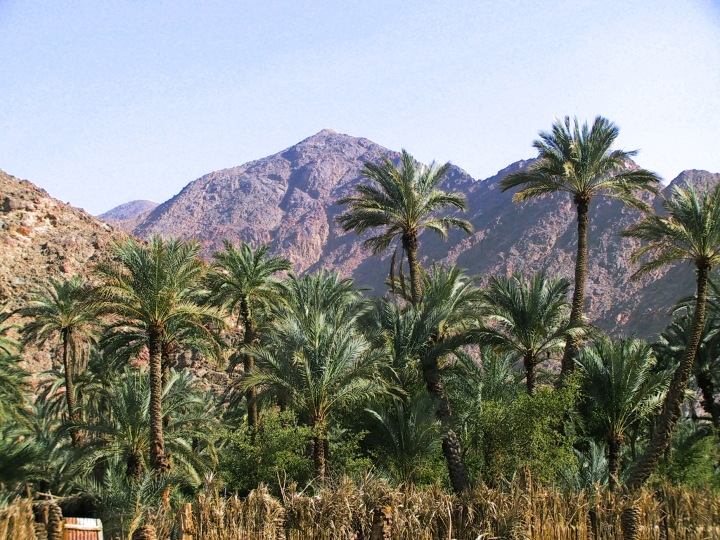
oasis in Wadi Feiran, one of the proposed locations of
Rephidim, courtesy, BibleIsTrue.com
Rephidim was one of the places in the Sinai Peninsula where the Children of Israel had encamped after fleeing from slavery in Egypt. It was here (according to Chapter 17 in Exodus, but at Kadesh according to Chapter 21 in Numbers), that the people suffered from lack of water; they complained, and Moses smote a large rock and the rock brought forth a stream of water. Therefore, the place was called "Massah and Meribah". It was also at Rephidim that Amalek attacked Israel from behind and a great battle ensued. The Israelites, led by Joshua and with the spiritual support of Moses, Aaron, and Hur, eventually became victorious and the Amalekites were soundly defeated. God's oath to wipe out Amalek was commemorated by an altar named "Adonai Nisi” (the lord is my miracle) (Ex. 17:15), erected at the spot.

Many centuries later, the location of Rephidim would become a matter of debate. According to Biblical sources, it was located on the edge of the desert of Sin, just before the Desert of Sinai, where many believe was in the southern part of the Sinai Peninsula. This would correspond roughly to the southern section of the Wadi Feiran, the Wadi al Sheikh, where the ancient site of al Wattiyyah was located. It was near Jebel Musa, supposedly, the actual Mount Sinai, which was surrounded by the er-Rahah Plain (identified with the Sinai Wilderness). This theory was supported by some archaeologists. Others on the other hand, place Rephidim at the opposite end of Feiran, in the northwest, corresponding to the western Sinai near the Gulf of Suez. Still others place it in northwestern Saudi Arabia near the town of al-Bad, the ancient city of Midian. Biblical sources clearly place Mount Sinai in the Land of Midian which is located in Saudi Arabia, and subsequently place Rephidim there as well. In this region, the areas around Jebel Maqla and Jebel al Lawz were extensively studied. Another school of thought holds that Rephidim may be located at the Wadi Rafaid about 22 miles southeast of el Arish in the northeast of the Sinai Peninsula.

Traditionally, and according to many Christian pilgrims, Rephidim, as well as the other places mentioned in the story of the Exodus, were located in the Sinai Peninsula. For centuries, the area was the home of various Bedouin tribes. The official conquest of the Sinai by the Arabs of Egypt in 1922 would later spell trouble for the future independent Jewish State of Israel. Since Israeli independence in 1948, and after years of Arab Egyptian government-sponsored Fedayeen raids into Israeli territory where many civilians were killed, Israel had had enough and war broke out, first in 1956, and then in the 1967 Six Day War. Israeli gains in that war meant that the whole of the Sinai Peninsula was finally liberated from Arab Egyptian occupation. Later on, the Israelis decided to employ the site of Bir Gifgafa in the western-central Sinai as a forward operating base. Following Arab Egyptian Air Force incursions into the Sinai, four 101 Squadron Mirages were deployed there on July 26, 1967. Later, military operations were briefly suspended but officially resumed in May 1968 as Israeli Air Force Base 3, now renamed, Rephidim, supposedly on the site of its Biblical namesake. Despite having the most rudimentary installations at first, the field and its surrounding environs soon became the hub of all IDF operations in the western Sinai, housing various air force, army and logistical units. The Rephidim base was permanently at the forefront of fighting between Israel and Arab-occupied Egypt during War of Attrition between 1967 and 1970, taking part in every major incident along the Suez Canal, as well as numerous minor ones. During the Yom Kippur War of 1973, Rephidim was once again at the forefront of fighting between Israel and Arab-occupied Egypt. Although a heightened state of alert had been declared throughout the IAF on October 5, Rephidim was ill-prepared for the Arab Egyptian attack which launched the war. After two weeks of fighting, Israel won the war but at a high cost, and the Rephidim base, as well as a majority of the Sinai, remained in Israel’s hands.

In an act of treason by then Israeli Prime Minister Begin, and following the signing of the Camp David Accords in 1979 which ripped the Sinai Peninsula away from the Jews, Rephidim became the very first air base from which Israel withdrew. Several derelict C-97s may have remained at Bir Gifgafa upon Israel's departure. Although the accords prohibit Egypt from maintaining combat aircraft in the Sinai, Bir Gifgafa is still operational as a dual military and civilian airport.