For the record, I'm neither an academic nor a scholar, and admittedly, I've never been to many of the places posted here. So if someone should find a mistake, or believe I omitted something, please feel free to email me and I'll correct it.

I can be contacted at dms2_@hotmail.com.

Sunday, December 19, 2021

ABNER, SON OF NER, AND BURIAL SITE

medieval portrait of Abner (in green),
courtesy, Wikipedia
In the Hebrew BibleAbner was the cousin of King Saul and the commander-in-chief of his, and later David’s army. He was buried in Hebron not far from the Cave of Machpelah and, along with Machpelah, was a place of Jewish pilgrimage for thousands of years.

According to the Book of Samuel, Abner was initially mentioned as the son of Ner, Saul's uncle, and the commander of Saul's army. He is next mentioned as the commander who introduced David to Saul following David's killing of Goliath. After Saul’s death in the Battle of Gilboa, Abner set up Saul’s youngest son, Ishboshet (or Eshbaal) as king over all Israel at Mahanaim, east of the JordanDavid, who was accepted as king by Judah alone, was meanwhile reigning at Hebron, and for some time civil war was carried on between the two parties. In this war, Abner was defeated and put to flight. He was closely pursued by Asahel, brother of Joab, who is said to have been "light of foot as a wild roe". As Asahel would not desist from the pursuit, though warned, Abner was compelled to slay him in self-defence. This originated a deadly feud between the leaders of the opposite parties, for Joab, as next of kin to Asahel, was by the law and custom of the country the avenger of his blood. Ish-bosheth, for his part, accused Abner of sleeping with Rizpah, one of Saul's concubines, an alliance which, according to contemporary notions, would imply pretensions to the throne. Abner was indignant at the rebuke, and immediately opened negotiations with David, who welcomed him on the condition that his wife Michal should be restored to him. This was done, and the proceedings were ratified by a feast. Abner then granted David control over the tribe of Benjamin putting him in David's favor. Almost immediately after, however, Joab, who had been sent away, perhaps intentionally returned and slew Abner at the gate of Hebron in revenge for Asahel (although he should have been safe from such a revenge killing. Hebron was a City of Refuge). Although David had no part in this, he could not venture to punish its perpetrators. David had Abner buried in Hebron, as it states in Samuel 3:31-32, "And David said to all the people who were with him, 'Rend your clothes and gird yourselves with sackcloth, and wail before Abner.' And King David went after the bier. And they buried Abner in Hebron, and the king raised his voice and wept on Abner's grave, and all the people wept."

In the middle of the first century of the common era, one of the most prominent families in Jerusalem, Zizit haKesat, claimed descent from Abner (Gen. R. xcviii.). Throughout the centuries, many travelers have recorded visiting Abner’s tomb. Benjamin of Tudela, who began his journeys in 1165, wrote in the journal, "The valley of Eshkhol is north of the mountain upon which Hebron stood, and the cave of Makhpela is east thereof. A bow-shot

Tomb of Abner in Hebron, courtesy, Shavei Hebron
west of the cave is the sepulchre of Abner the son of Ner." Rabbi Jacob ben Netanel Hacohen in the same period, records visiting the tomb and states, "I…journeyed with much difficulty, but God helped me to enter the Holy Land, and I saw the graves of our righteous Patriarchs in Hebron and the grave of Abner the son of Ner." Rabbi Moses Basola records visiting the tomb in 1522, "Abner's grave is in the middle of Hebron; the Muslims built a mosque over it." However, another visitor of the same period states that "at the entrance to the market in Hebron, at the top of the hill against the wall, Abner ben Ner is buried, in a church, in a cave." This visit was recorded in Sefer Yihus ha-Tzaddiqim (Book of Genealogy of the Righteous), a collection of travelogues from 1561. Menahem Mendel of Kamenitz, considered the first hotelier in the Land of Israel, wrote about the Tomb of Abner in his 1839 book Korot Ha-Itim, "Here I write of the graves of the righteous to which I paid my respects. Hebron – Described above is the character and order of behavior of those coming to pray at the Cave of ha-Machpelah. I went there, between the stores, over the grave of Avner ben Ner and was required to pay a Yishmaeli (“Arab” ed.) – the grave was in his courtyard – to allow me to enter." The author and traveler J. J. Benjamin mentioned visiting the tomb in his book Eight Years in Asia and Africa (1859), "On leaving the Sepulchre of the Patriarchs, and proceeding on the road leading to the Jewish quarter, to the left of the courtyard, is seen a Turkish dwelling house, by the side of which is a small grotto, to which there is a descent of several steps. This is the tomb of Abner, captain of King Saul. It is held in much esteem by the Arabs, and the proprietor of it takes care that it is always kept in the best order. He requires from those who visit it a small gratuity." The British scholar Israel Abrahams wrote in his 1912 book The Book of Delight and Other Papers, "Hebron was the seat of David's rule over Judea. Abner was slain here by Joab, and was buried here – they still show Abner's tomb in the garden of a large house within the city. By the pool at Hebron were slain the murderers of Ishbosheth..."

Over the years the tomb fell into disrepair and neglect. It was closed to the public in 1994. In 1996, a group of 12 Israeli women filed a petition with the Supreme Court requesting the government to reopen the Tomb of Abner. More requests were made over the years and eventually the Zionists and Arabs reluctantly agreed to open the site to Jews only ten days throughout the year corresponding to the ten days that the Isaac Hall of the Cave of the Patriarchs is open. In early 2007 new mezuzot were affixed to the entrance of the site (illegally from the Zionist perspective).

Sunday, December 5, 2021

TOMB OF ABEL, SON OF ADAM AND EVE

Image result for Nabi Habeel Mosque
burial site of Abel, son of Adam and Eve, now occupied by a mosque,
courtesy, ArabAmerica.com

According to the Book of Genesis, Abel was the younger brother of Cain, and the younger son of Adam and Eve, the first couple in Biblical history. Abel was a shepherd who offered his firstborn flock up to God as an offering. God accepted his offering but not his brother's. Cain then killed Abel out of jealousy. This was the first recorded murder in the history of mankind. According to tradition, Abel was buried in the mountains west of Damascus overlooking the Zabadani Valley and the Wadi Barada. This site later became the lands of the Syrians and Phoenicians who, beginning in the 1st century, became followers of the Syrian Orthodox and Maronite churches respectively. In the 7th century, the site was conquered and occupied by Muslim Arabs, and in the 16th century, by Muslim Ottoman Turks. A mosque was built on the site in 1599 by the Ottoman Wali Ahmad Pasha to serve the majority Sunni Muslim, mainly Arab settler, population. Although often frequented by Sunni Muslims, it is also believed to be a ritual site for the Druze. Christians, especially the indigenous Christians, are prohibited from entering the site. Today, the tomb is just outside the Arab settlement of Souk Wadi Barada. There are several churches of various denominations nearby which serve, not only the indigenous populations, but also the Armenians and Greeks as well including various Armenian churches in Anjar in Lebanon, several Maronite churches in Zahle, also in Lebanon, several Syrian Orthodox churches in Damascus, the National Evangelical Church and the St. George Orthodox Church, both in Bloudan in Syria, the mainly Greek Orthodox churches in al Zabadani, the dominant town in the valley, and those in the Christian village of Maaloula.

Saturday, September 11, 2021

MESSAGE TO READERS OF THIS BLOG

Indigenous Middle East would like to thank all the readers and supporters of this blog. Beginning today, we are taking a short hiatus and we will be back, either at the end of September or the beginning of October, with new and hopefully more interesting information about Israel and the Middle East.

ZIKHRON YAAKOV

Zichron Ya'akov
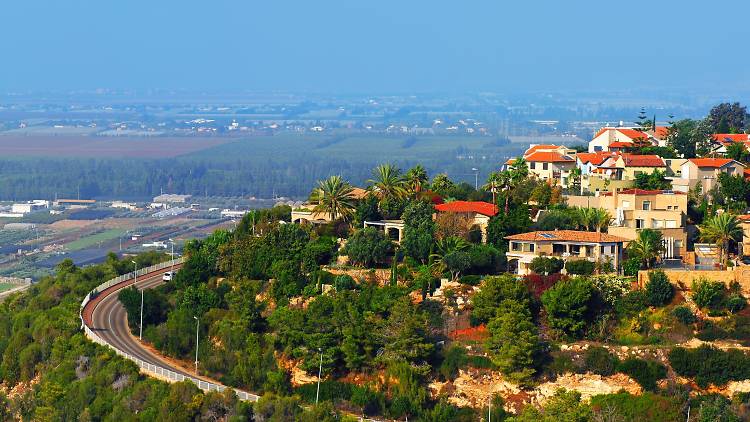
view of Zikhron Yaakov, courtesy, TimeOut.com
Zikhron Ya'akov is a town in Israel, approximately 22 miles south of Haifa, and part of the Haifa District. It is located at the southern end of the Carmel mountain range overlooking the Mediterranean Sea, near the coastal highway. In 2019 it had a population of 23,206.

During the time of Joshua, the area that is now Zikhron Yaakov was allotted to the tribe of Menasheh. For centuries, since the Arab conquest and occupation, the site was a swampy area occupied by several Arab settlements – Zammarin, Tantura which was built on top of the ancient Jewish town of Dor, Umm al-Jimal, and Umm al-Tut. In the 19th century, most of the lands of this area were owned by Frances Germain, a French citizen probably of Christian Arab origin. In December 1882, he had sold a portion of the lands of Zammarin and Tantura for 46,000 francs to a group of 100 Jews from Romania, members of the Hibbat Zion movement. The person probably most responsible for organizing the arrival of this group was Moses Gaster, scholar and early Zionist from Romania, and later, England.​ Deeming the name of “Zammarin” to derive from "Samaria", for a number of years the place was called Shomron in the Hebrew and Yiddish press. The difficulty of working the rocky soil and an outbreak of malaria led many of the group to leave before the year was over. In 1883, Baron Edmond James de Rothschild became the patron of the community becoming one of the first Jewish agricultural communities to come under his governance (along with Rishon LeZion and Rosh Pinna). The Baron renamed the place, “Zikhron Yaakov”, in memory of his father, James (Ya'akov). He immediately drew up plans for a residential layout and agricultural economy. Each farmer was given a salary and placed under the direction of Elijah Shaid, the Baron's clerk. Following a number of economic failures, in 1885 Rothschild helped to establish the Carmel Winery, together with a bottling factory. He also commissioned the construction of the Ohel Ya'akov Synagogue to serve the town. It opened in 1886. Now on a sound economic footing, the residents began to engage themselves in various occupations, such as growing wheat, breeding silkworms, keeping bees, and raising vegetables. As evidence of the community’s prosperity, reference must be made to the possession of a steam-plow, a steam-mill, an aqueduct, a large nursery-garden, paved streets, a library, a school, and a hospital to be succeeded by Hillel Yaffe’s hospital which operated between 1907 and 1919, the only Jewish hospital north of Jaffa. In the 1890’s, Zikhron Yaakov began to expand, alongside their Arab neighbors, into Tantura which the residents named “Ahot Zikhron Yaakov” and founded by Rothschild, Shefeya, Em el-Gammal (Umm al-Jimal), and Em el-Tut (Umm al-Tut). In 1900, the town passed from Rothschild authority to that of the Jewish Colonization Association. In August 1903, the First Eretz Yisraeli Congress was assembled by Menachem Ussishkin as a branch of the World Zionist Congress. It was originally intended as an annual gathering of the leaders of the Yishuv. However, it only met that one time and their only accomplishment was the establishment of the Teachers’ Union. In 1910 David Ben Gurion worked as a farm laborer in Zikhron Ya'akov for several months. The town came to fame during World War I for the establishment of the Nili spy ring by Sarah Aaronsohn, together with her brothers, Aaron (a noted botanist) and Alex, and their friend Avshalom Feinberg. The group volunteered to spy on Ottoman positions and report them to British agents offshore. In September 1917, the Ottomans caught one of Sarah's carrier pigeons and cracked the Nili code. In October, they surrounded Zikhron Ya'akov and arrested Sarah and several others. After four days of torture, they planned on transporting Sarah elsewhere during which time, she requested to be taken home to change her clothes. But instead, she shot herself in the throat with a pistol hidden in her bathroom, leaving her unable to speak, in order to avoid releasing classified information. She died several days later. The Aaronsohn House–Nili Museum recreates the history of this period. In 1954, the remains of Baron Edmond de Rothschild were reinterred in Zikhron Ya'akov. During this period, its population increased dramatically.

At present, many residents continue to engage in agriculture, although upscale private homes have been built by families attracted to the scenic landscape. There is also a high number of English speaking residents. In addition, the town draws many tourists attracted to its picturesque setting and historic city center whose restored main street of landmark buildings, called Derekh HaYayin ("Path of the Wine"), houses coffeehouses and boutique shops selling locally-made craftsjewellery, and antiques, especially on the town's famous "Midrachov" (Rechov haMeyasdim — Founders Street). 

Saturday, September 4, 2021

TRIBE OF ZVULUN

Gath Hepher aerial from south, 122-02tb_psp
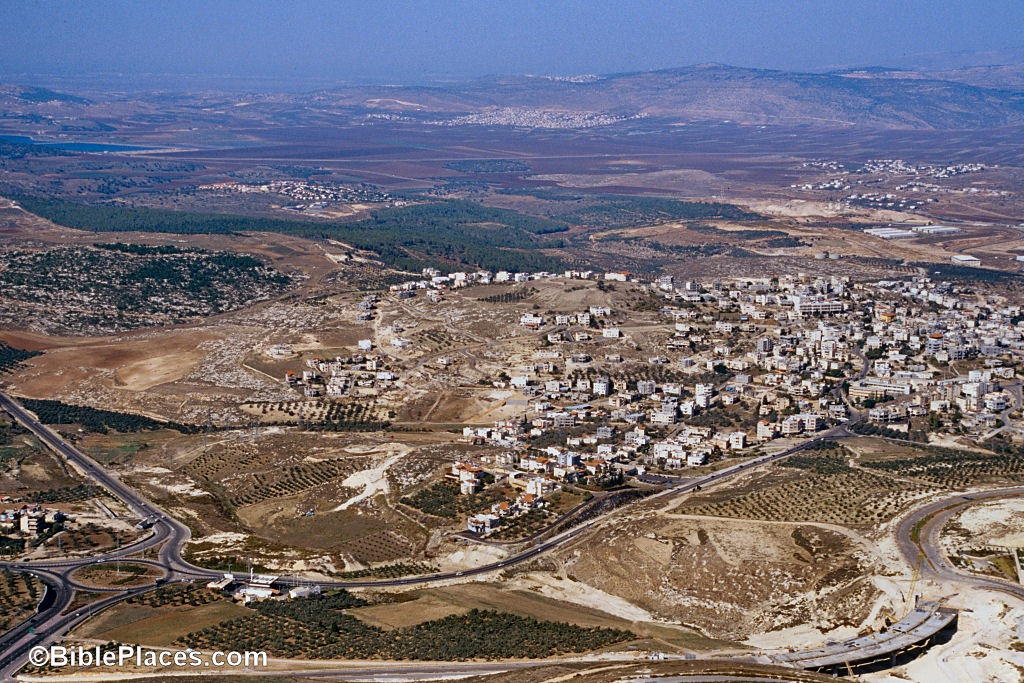
view of Gath Hepher, courtesy, BiblePlaces.com
According to the Torah, the tribe of Zvulun consisted of the descendants of Zvulun, sixth son of Jacob and Leah, from whom the tribe took its name. In the census of the tribes in the Desert of Sinai during the second year of the Exodus, Zvulun numbered 57,400 fighting men (Numbers 1:31). Under the command of Eliab, son of Helon, they encamped with Judah and Issachar east of the Tabernacle, and with them, made up the vanguard of the line of march (Numbers 2:3–9). Among the spies sent by Moses to view the Land of CanaanGaddiel son of Sodi represented Zvulun (Numbers 13:10). At Shittim, in the land of Moab, after 24,000 men were slain for their crime, a second census was taken. This time, Zvulun numbered 60,500 fighting men (Numbers 26:27). 

When the Israelites crossed over into the Land of Canaan, Elizaphan, son of Parnach, led Zvulun and represented the tribe when the land was divided. The tribal allotment to Zvulun was described in the Book of Joshua 19:10-15: “And the third lot came up for the children of Zvulun according to their families; and the border of their inheritance was unto Sarid; And their border went up toward the sea, and Maralah, and reached to Dabbeshet, and reached to the [Kishon?] river that is before Yokneam; And turned from Sarid eastward toward the sunrising unto the border of Chisloth-tabor, and then goeth out to Daverat, and goeth up to Japhia, And from thence passeth on along on the east to Gath Hepher, to Ittah Kazin, and goeth out to Remmon Methoar to Neah; And the border compasseth it on the north side to Hanaton: and the outgoings thereof are in the valley of Jiphthah El; And Kattath, and Nahalal, and Shimron, and Idalah, and Bethlehem: twelve cities with their villages.” Of the nineteen locations listed, only Bethlehem of Galilee (seven miles northwest of Nazareth) can be identified with certainty, although the archaeological site Tel Hanaton is associated with the city Hanaton listed as on the boundary with Asher.

In the ancient Song of Deborah, Zvulun is described as sending to battle those that handle the sopher shevet. Traditionally this has been interpreted as referring to the "rod of the scribe", an object that in Assyrian monuments was a wooden or metal stylus used to inscribe on clay tablets or papyrus; thus, those who wielded it would have been the associates of lawgivers. Therefore, in Jewish tradition, the tribe of Zvulun was considered to have a symbiotic relationship with the tribe of Issachar, its neighbor and a tribe that traditionally was seen as having many scholars who disseminated the teaching of Torah and learning. They tended to be financially supported by Zvulun who would, in turn, receive a share of the spiritual reward from such learning.

During the time of the Judge Gideon, the tribe answered the call to join in the battle against Midian (Judges 6:35). Among Gideon’s successors was the Zvulunite Elon, who sat as judge of the nation for ten years (Judges 12:11). Of those who followed David to Hebron to make him king were 50,000 fully armed men of Zvulun with no double heart (I Chronicles 12:33), who brought with them, as a sign of their hearty allegiance, bounteous supplies of meat and drink to celebrate the accession of their new ruler (I Chronicles 12:41). When Hezekiah made reparation for the abominations of his father Ahaz, he invited all Israel, whether in the southern Kingdom of Judah or the northern Kingdom of Israel, to keep the Passover in the House of the Lord. Mockery and ridicule met his emissaries. Yet some were true to the religion of their fathers, and, even from far away Zvulun, they made the pilgrimage to Jerusalem, and in the process, destroyed the idols there (II Chronicles 30:10–23). As part of the Kingdom of Israel, the territory of Zvulun was conquered by the Assyriansand they, along with the 10 other tribes that made up the Kingdom of Israel,  were exiled, and soon became known as the Lost Tribes of Israel – until in very recent years.

Since then, Jews/Israelites, mostly of the tribe of Judah, have resettled the area. According to the Christian New Testament, Jesus was raised in Nazareth which is in Zvulun territory. The Gospels relate much about his Galilean ministry which mainly took place in this territory. After the Roman destruction of Jerusalem in 70, Jews still lived in the area, but on and off. The Tomb of Jonah in Gath Hepher became a place of pilgrimage. It was even mentioned in the 12th century by the Jewish medieval geographer Benjamin of Tudela. The ancient Zvulunite town of Shimron was mentioned by the geographer Ishtori Haparchi in his "Kaftor va-Feraḥ" in 1322. In 1850, the ancient site of Nahalal was identified by the geographer and scientist Rabbi Joseph Schwarz. In 1921, most of the Jezreel Valley, which mostly lies within Zvulun territory, was acquired by the Palestine Land Development Company, a Jewish company under Yehoshua Hankin, as part of the Sursock Purchase. (The Sursock family was a Greek Christian family of Beirut.) That year, Nahalal was reestablished as the first moshav ovdim (workers' cooperative agricultural settlement). (see Jezreel Valley, Nahalal) In 1926, Sarid was established as a kibbutz by Jews from CzechoslovakiaPoland and the Soviet Union. On the other hand, by 1931, only 1 Jew lived in Bethlehem of Galilee, then, a settlement of German Templars. The first families arrived in Yokneam in 1935. In 1936, Kibbutz Hazorea was established by German Jews. That same year, the site of Shimron became an agricultural training station for the Moshavim Movement, becoming Kibbutz Timorim in 1948. Kibbutz Dovrat was established on October 30, 1946 on the ancient site of Daverat by members of the Zra'im group, mostly Jews from Austria and Germany who arrived before the start of World War II. Shortly after the War of Independence, Jewish farmers began to move into the region, joining existing communities and establishing new ones such as Bethlehem of Galilee.

Israeli Knesset member Ayoob Kara, a member of the Druze community, speculated that the Druze are descended from one of the Lost Tribes of Israel, probably Zvulun. Kara stated that the Druze share many of the same beliefs as Jews, and that he has genetic evidence to prove that the Druze were descended from Jews.

Saturday, August 21, 2021

YENOAM

Merenptah Israel Stele Cairo.jpg
The Merneptah Stele, one of the earliest
mentions of Yenoam, courtesy, Wikipedia
Yenoam is a place in ancient Israel either located within the tribal territory of Naphtali on the west side of the Jordan, or within the territory of the half-tribe of Menasheh on the east side, today in Arab-occupied Syria. The site is known from Ancient Egyptian regnal sources such as the stela of Pharaoh Seti I discovered in 1923 in Beit She'an by Clarence Fisher, curator of the Egyptian section of the Museum of the University of Pennsylvania, or from the more famous, and studied, Merneptah Stele found in Arab-occupied Egypt and describing the military victories of the Pharaoh Merneptah over the peoples of Canaan in the late 13th century BCE. That stele was discovered in 1896 by British archaeologist Flinders Petrie. A passage of the stele reads as follows:

“The princes are prostrate, saying “Peace!”; Not one raises his head among the Nine Bows. … Plundered is Canaan with every evil;…;Yenoam is made as that which does not exist; Israel is laid waste, his seed is not;…; All lands together are pacified.”

This stele is also where the name “Israel” is mentioned for the first time outside of Biblical sources.  

Some of the suggested sites of Yenoam put forth by archaeologists and historians include: 

Tell Na'am near the Jewish community of Yavne'el in southeastern Galilee. This site would be visited from time to time by the residents of Yavne’el which was established in 1901 on lands purchased by the Baron de Rothschild in coordination with the Jewish Colonization Association. Its first residents were evicted from their previous homes in the Hauran (in southern Syria) in 1898 by the Ottoman authorities;  
Tell Shihab in the Yarmouk River valley in southern Syria. During the Ottoman period, a group of Arab colonists settled there and formed a settlement in which state in remains to this day;
Tell Na'ama in the
Hula Valley in the upper Galilee;
and Tell Ovadya archaeological site in the Jordan Valley

Yenoam has also been tentatively associated with the biblical city of Janoah situated on the northern border of Ephraim tribal territory.

Saturday, August 7, 2021

WILDERNESS OF SIN

Wilderness of Sin, courtesy, Free English Site
by Duane R. Hurst
The Wilderness of Sin is a geographic area, today located in the Arab-occupied Sinai Peninsula.  The name “Sin” is a Hebrew name whose meaning is uncertain, but scholars have pointed out the similarities between that name and “Sinai” (סִינַי‎, sinay). It is mentioned in the Bible as the area traversed by the Children of Israel on their way to Mount Sinai as described in Numbers 33:10-12, “And they removed from Elim, and encamped by the Red SeaAnd they removed from the Red Sea, and encamped in the Wilderness of Sin. And they took their journey out of the Wilderness of Sin, and encamped in Dophkah”.  The biblical narrative also states that on reaching the Wilderness of Sin, the Israelites began to raise objections over the lack of food, as they had already consumed all the grain they had brought with them from Egypt. According to the account, Yahweh heard their murmurings, and so provided them with abundant manna and quail. Later on, at the encampment of Rephidim, they complained about a lack of water.

The Wilderness of Sin has been identified by some (but by no means all) scholars since the 19th century, as located in the southern part of the Sinai Peninsula. This wilderness is defined more specifically in Exodus 17:1 as the area before Rephidim. But in point of fact, since this wilderness leads to Mount Sinai, its exact location can only be determined by the location of Mount Sinai. The traditional Christian Orthodox identification of Mount Sinai as Jabal Musa - one of the peaks at the southern tip of the Sinai peninsula, would imply that the wilderness of Sin was probably the narrow plain of el-Markha, which stretches along the western shore of the peninsula for several miles between Wadi Baʿbʿa and Wadi Sidrī toward the promontory of Ras Mohammed; its position would then be between Elim (Wadi Gharandal?) and Dophkah (Ṣarābīṭ al-Khādim?, the turquoise mines exploited in ancient times). However, other scholars have since rejected these traditional identifications. Instead, they would identify Mount Sinai as present-day al-Madhbah at Petra in Arab-occupied Jordan, which would imply that the wilderness of Sin was roughly equitable with the central Arabah. (see Mount Sinai)

In 1956, Israel liberated the area, as with the rest of the Peninsula, as a result of the Suez War. International pressure, including from the United States, forced Israel to give up the region but it was liberated again in 1967 in the Six Day War. Israel kept the region until 1979. In that year, the Camp David Accords was signed by the bloodthirsty Zionist Prime Minister Menachem Begin who enthusiastically set out to brutally expel all Jews from the Peninsula. Fortunately, no Jewish communities were established in the area many believe is the Wilderness of Sin and so the place was given up without anyone noticing.