For the record, I'm neither an academic nor a scholar, and admittedly, I've never been to many of the places posted here. So if someone should find a mistake, or believe I omitted something, please feel free to email me and I'll correct it.

I can be contacted at dms2_@hotmail.com.

Friday, July 19, 2019

BEERSHEBA, ISRAEL

Image result for old city of beersheba
Beersheba, courtesy IsraelCities.com
The city of Beersheba is the largest city in the southern Negev region of Israel, with a population of over 200,000. It has acted as the “capital” of the Negev for decades. Awarded to the prospective Arab state in 1947, it was recaptured by Israel following attacks from there by local Arabs as well as the Arab army of Egypt.
The history of Beersheba goes back to pre-Hebraic times but written records are first mentioned in Biblical sources. In the Book of Genesis, the site of Beersheba was recorded as being under the control of the Philistines. It was here that Abraham dug a well that was later violently taken away by the servants of Abimelech, king of the Philistines. Promised protection, Abraham and Abimelech made an oath with seven ewe lambs and the name of the place was henceforth called “Beersheba” (well of seven). Abraham’s son Isaac renewed the oath. For a time, it was the dwelling place of Isaac’s son Jacob, before his sojourn in Egypt.
After the conquest of Canaan by Joshua, Beersheba was allotted to the tribe of Shimon. It was the southernmost city settled by the Israelites, hence the expression "from Dan to Beersheba" which described the whole of Israelite territory from north to south.
The sons of the priest-judge Samuel were judges here.
Saul, Israel's first king, built a fort here for his campaign against the Amalekites.
During the period of the divided kingdom when Ahab ruled in the north and Asa ruled in the south, Beersheba was considered the gateway to the desert. The prophet Elijah, while escaping the wrath of Queen Jezebel, wife of King Ahab, took refuge in Beersheba before continuing on his journey to Mt. Horeb.
Under the Roman occupation, the native Israelites slowly abandoned the city and Christians, and later the Byzantine Christians, gradually took over. Then during the Muslim conquest in the 7th century, Beersheba was totally abandoned and destroyed. It remained abandoned until the late 19th/early 20th centuries when the modern city was built by the Ottoman Turks for the Bedouin of the area, acquiring the nickname as "the first Bedouin city." By 1914, Beersheba had a population of 1000, made up mostly of Bedouin and non-Bedouin Arabs from the Hebron and Gaza areas, as well as a small number of Jews one of whom, ran a flour mill.
In World War I, Turkish fortifications were laid out around the town and more settlers, including Jews, came and provided services to the Turkish army. In 1920, now under British rule, a few Jewish laborers planted a tree nursery and eucalyptus grove there and experimented with cultivating vegetables and other crops. In 1922, the population reached 2,356, among whom were 98 Jews. Due to the Arab riots in 1929 when many Jews were ethnically cleansed from various parts of Palestine including Beersheba, the number of Beersheba Jews decreased to 11. These last Jews were, as well, ethnically cleansed during the 1936–39 riots. In spite of this, efforts were intensified to purchase land for Jewish settlement in the Negev.
Following the conclusion of the War of Independence, the 1949 Armistice Agreements formally granted Beersheba to Israel. After a few months, the town's war-damaged houses were repaired. As a post-independence wave of Jewish immigration to Israel began, Beersheba experienced a population boom as thousands of immigrants moved in. They came mainly from North Africa, Iraq, India, Romania, Poland, Hungary, and South America. The city rapidly expanded beyond its core, which became known as the "Old City" as new neighborhoods were built around it, complete with various housing projects such as apartment buildings and houses with auxiliary farms, as well as shopping centers and schools. The Old City was turned into a city center, with shops, restaurants, and government and utility offices. An industrial area and one of the largest cinemas in Israel were also built in the city. It was also a communication center linking to the Lod-Kiryat Gat and Dimonah-Oron highways. A pumping station of the Eilat-Haifa oil pipeline was located there. Its largest industries (ceramics, sanitary ware, fire-resistant bricks, pesticides and other chemicals, and bromide compounds) exploited Negev minerals. There was also a large textile factory, flour mill, machine garage, and smaller plants for building materials, diamonds, metals, and other industries. The city had several academic, scientific, and cultural institutions. Among the first was the Municipal Museum. In 1957, the Negev Institute for Arid Zone Research was established, experimenting in water desalination by electrodialysis, exploitation of solar energy, cloud seeding, adaptation of plants to aridity, hydroponics, and human behavior under desert conditions. Other endeavors were: Soroka Hospital (opened in 1960), Ben Gurion University (originally the Institute for Higher Education which opened in 1965, becoming the University of the Negev in 1970, and finally its present name in 1973), the Beersheba Theater and the Symphony Orchestra (both 1973), Shamoon College of Engineering (1995), and the city's tallest building, Rambam Square 2, a 32-story apartment building (2003). The city also serves as a market center for the Negev's tens of thousands of Bedouin. The traditional Thursday, Bedouin market day, is a noted tourist attraction.
Other tourist attractions are the many sites of ancient remains including those at Tell el-Sheba, the most ancient site of Beersheba. In addition, a park, to be called Beit Eshel Park, will be established around the nearby Biblical town of Beit Eshel at the official entrance to the river park.
As with the rest of Israel, Beersheba has also seen its fair share of terrorist incidents. 1998: sixty four people were wounded in a grenade attack; 2004: sixteen people were killed in two suicide bombings on commuter buses in Beersheba for which Hamas claimed responsibility; 2005: another suicide bomber attacked the central bus station, seriously injuring two security guards and 45 bystanders; 12/27/2008-1/18/2009: During Operation Cast Lead, Hamas fired over 2000 rockets and mortars from Gaza into southern Israel, including Beersheba; 2010: an Arab attacked and injured two people with an axe; 2012: a Palestinian from Jenin was stopped before a stabbing attack in a "safe house"; 2015: a lone gunman shot and killed a soldier guarding the Beersheva bus station before being gunned down by police; 2016: the Shin Bet thwarted a Palestinian Islamic Jihad terror attack at a wedding hall.

Thursday, July 4, 2019

BASHAN / GOLAN HEIGHTS

southern Golan Heights, courtesy Wikipedia

In Biblical times, the ancient territory of Bashan, which lies to the east of the Jordan, formed the bulk of the eastern half of the Israelite tribal territory of Menasheh. Today, about half of the territory consists of Israel’s Golan Heights with its “capital” being the revived ancient town of Qatzrin, and the other half in, what is today, the southern half of Arab-occupied Syria but with a large Druze population.

After the Biblical period, this area continued to contain an ancient Jewish community. In the 7th century, while various Arab clans migrated here, the indigenous Jews were joined by Jewish refugees from Khaibar in Arabia, who were expelled by Mohammed, especially the tribes of Kainuka and Wuld Ali, who settled among the native Jews in Edrei, which became a rabbinic center in the Middle Ages. Today, Edrei is known as Deraa, an Arab-occupied town in Arab-occupied southern Syria.
Around the same time, Bashan became home to groups a Druze and Circassians, who came in peace. In time, the Druze became the majority and several settlements including that of Majdal Shams, the ancient Migdal Shemesh, became their main population centers. During the 11th century, there was also a relatively large Jewish community in Banias. They were referred to a Baniasites who were frequently mentioned in the documents of the Cairo Geniza. Eventually, Babylonian Jews as well as a number of Karaites had also settled in Banias, causing the community to divide into Palestinians, Babylonians, and Karaites, who differed in their version of prayers. During the period of Crusader rule, in the early 12th century, the famous proselyte Obadiah the Norman passed through the town and wrote of a Karaite pseudo-messiah Solomon haKohen who would preach of the coming redemption. But in c. 1170, Benjamin of Tudela mentions no Jews at all and it is possible that the community ceased to exist by then. Later however, Banias was re-inhabited by Jews as were some of the other villages in the Bashan area.

By the early 14th century, Jews inhabited three main areas in Bashan – Banias, Edrei, and Salkhad, and questions arose as to whether these areas, as well as others immediately to the east of the Jordan, were halachically part of the Land of Israel. After constant debate, which lasted for over two centuries, during which time, the Jews of Edrei were forced to leave due to Arab depredations, it was decided in the affirmative, and the area was officially recognized as part of the Land of Israel. During the early Ottoman period, Banias still had a Jewish population as attested by a document from 1624 which mentions the murder of a Jewish physician, Elijah haKohen, by an Arab sheikh. During the 18th and 19th centuries, Druze tribes from Lebanon migrated to the eastern part of Bashan and mainly concentrated in and around the mountain which eventually became known as Djebel Druze. It remains their stronghold til today.

By the 19th century, there were, once again, no Jews left in all of Bashan. It was in fact only sparsely inhabited and the land was largely uncultivated. In 1880, Laurence Oliphant published “Eretz haGilad” (The Land of Gilead), which described a plan for large-scale Jewish settlement in the Golan, but the Turks snubbed the scheme. In 1886, native born Jews from Safed formed the Bnei Yehuda Society and purchased 14,000 dunams of land near the Circassian village of Ramthaniya in the central Golan on which, they attempted to establish the village of Golan b’Bashan. But due to financial hardships and the long wait for a kushan (Ottoman land deed), the village was abandoned after a year. Soon afterwards, the Society regrouped and purchased land next to the Bedouin village of Bir Shaqum in the southern Golan. And thus, the village of Bnei Yehuda was established. Between 1891 and 1894, Baron Edmond James de Rothschild purchase nearly 30 sq. miles of land consisting of 16 villages in the eastern Bashan for Jewish settlement. Most of the land straddled both sides of the Nahr el Allan. Today, this land lies just a few miles from the 1967 lines, inside Syria where Jews are forbidden to live. Also in the 1890s, the Russian Agudat Achim Association acquired land in several locations in the districts of Fiq and Deraa and at Jillin where a farm was built and extensive eucalyptus groves were planted. Other tracts of land were acquired by Jewish organizations based in Romania, Bulgaria, the United States, and England, but Jewish settlement in the area remained slow and tenuous. Meanwhile, Jews had managed to build a road stretching from Lake Huleh to Muzayrib and by the mid-1890s most of the Golan had become owned and cultivated by a variety of peoples. A Jewish village called Tiferet Binyamin was set up on lands at Saham el-Jolan by the Shavei Zion Association based in New York, but the project was abandoned after a year when the Turks issued an edict in 1896 evicting the residents on the grounds that they were not Ottoman citizens. A later attempt to resettle the land with Syrian Jews who were Ottoman citizens also failed.
In 1899, the pasha of Damascus expelled the Jews from all of the Rothschild’s estates. Between 1904 and 1908, a group of Crimean Jews settled in the Bethsaida Valley, initially as tenants of a Kurdish proprietor with the prospects of purchasing the land, but the arrangement faltered and most of the Jewish settlements in the region were abandoned over time either due to Arab hostility and Turkish bureaucracy, diseases, or economic difficulties. Bnei Yehuda was the sole exception.

1920 witnessed the first of a series of Arab pogroms which raged throughout the country resulting the massacres and expulsions of Palestinian Jews whether they were immigrants or not. Bnei Yehuda was one such victim community following an Arab attack. But the land itself was still owned by Jews. Meanwhile, the Palestine Jewish Colonization Association obtained the deeds to the Rothschild lands and continued to manage it, collecting rents from the Arab peasants living there. In the 1920s, the British, who now occupied Palestine succeeding the Ottoman Empire after World War I, began a policy of dividing Palestine among Arab groups. In 1922, the Golan Heights were given over to the newly-formed Arab country of Syria, under French rule, and the rest of eastern Palestine was created into the Hashemite Arab Kingdom of Transjordan, under British rule. Western Palestine became more difficult to divide. Meanwhile, along the eastern shore of the Sea of Galilee, which remained part of western Palestine, Ein Gev and Shaar Hagolan were established in 1937. In 1947, the (largely Arab) Syrian Land Settlement Campaign refused to recognize the PJCA as the legal owner of any land in Syria, and the Syrian government confiscated it without compensation on the grounds that “it was contrary to Syrian policy to allow Jews to own land in Syria.”

In the late 1950s, the PJCA transferred the Golan/Syrian landholding to the Jewish National Fund. Today, the JNF still lay claim to the land. In the period between Israel’s War of Independence in 1948 and the Six Day War in 1967, Syria occupied the Golan Heights and Syrian Arabs constantly harassed Israeli border communities by firing artillery shells from their dominant positions there. In October 1966 Israel brought the matter up before the United Nations. Five nations sponsored a resolution criticizing Syria for its actions but it failed to pass due to a Soviet veto. Aside from this little charade, the Israeli government refused to do anything about the situation. One of the laziest and pathetic of Israel’s officials, Golda Meir, summed up life in Israel’s border communities:

The Syrians seemed bent on an escalation of the conflict; they kept up an endless bombardment of Israeli settlements below the Golan Heights, and Israeli fishermen and farmers faced what was sometimes virtually daily attacks by snipers. I used to visit the settlements occasionally and watch the settlers go about their work as though there’s nothing at all unusual in plowing with a military escort or putting children to sleep – every single night – in underground air raid shelters.

In 1967, Israel uncharacteristically finally decided to do something. After the Six Day War broke out in June, Syria’s shelling greatly intensified. The war on the northern front ended when the Israeli army managed to reunite the Golan with the rest of Israel. Jewish re-settlement in the Golan began soon after the war with the establishment of Merom Golan the following month. By 1970 there were 12 such communities. Today, the area is well developed and consists of many sites: Mount Hermon, the highest point in Israel at around 9000 feet, its Ski Resort and Nature Reserve, the Hermon Stream Nature Reserve, the ruins of Gamla known as the Masada of the north, and its ancient synagogue, the Odem Forest, Nimrod Fortress National Park, the Banias Waterfalls, Hermonit Mountain Reserve, Avital Mountain Reserve, Qatzrin Forest and Park including an ancient synagogue, Nahal Mehsushim Nature Reserve, Betzaida Zachi Reserve, Jordan Park, Magrase Nature Reserve, Yarmouk Nature Reserve (today located in the Kingdom of Jordan) and the River of the same name which forms part of the border between Israel and Jordan, the ancient town of Hamat Gader and its ancient synagogue, al Quneitra (today in the demilitarized zone between Israel and Syria but under Syrian Arab control), and the ancient synagogues of En Nashut, Dabura, Dabiyye, Assaliyye, Zumeimira, Dikkeh, Kanaf, and Qanatir.

Saturday, June 29, 2019

BALFOUR FOREST, ISRAEL


Image result for balfour forest israel
Balfour Forest, courtesy KKL-JNF, photo: Dennis Zin
In Biblical times, the area that is now the Balfour Forest in the hills west of Nazareth, as with the rest of the Land of Israel, was a well-wooded and well-farmed region and located in the tribal territory of Zvulun. After the destruction of Jerusalem by the Romans in 70 and the consequent occupation and invasions of foreign empires – Arabs, Crusaders, Mameluke Egyptians, and Ottoman Turks, etc., and their havoc on the land, Israel gradually became denuded of any forestry whatsoever with the exception of a few small areas scattered throughout the country. It wasn’t until c. 1870 that Jews started to re-plant trees, further south at Mikve Yisrael outside of Jaffa. Around the same time, the Sursock family, a Greek Christian family resident in Beirut, purchased from the Ottoman government, large swathes of the Jezreel Valley, including the Nazereth hills which was sparsely covered with steppes and shrubberies at the time.

With the founding of the Jewish National Fund in 1901, tree planting and land reclamation became more organized and on a national scale. In 1921, after lengthy negotiations, the Sursock landholdings were legally transferred to the JNF and Kibbutz Ginegar was founded the following year west of Nazareth and at the southern foothills. It was the wish of the JNF as well as of the Jewish leadership that this area be made to look like what it was originally in Biblical times and the idea for the Balfour Forest was born, named after Arthur Balfour, British Secretary of State for Foreign Affairs at the end of World War I, who was sympathetic to Jewish national aspirations in the Jewish ancestral homeland.

This was to be the JNF’s first major forestry project, requiring a large amount of capital. So fund-raising began almost immediately spearheaded by the Balfour Forest Committee based in London and headed by Major George Nathan, assisted by the Marquess of Reading. The funds were then transferred to the JNF and, in 1928, on the barren hilltop north of Ginegar, the planting of the forest commenced attended by Jewish and British officials including Menachem Ussishkin, chairman of the JNF, Sir Alfred Mond, accompanied by Lady Mond, who planted the first saplings, Chaim Weizmann, president of the World Zionist Organization, David ben Gurion, head of the Executive of the Jewish Agency for Palestine, High Commissioner Lord Plumer and Lady Plumer, Harry Sacher of the Palestine Zionist Executive, David Yellin, chairman of the Vaad Leumi (the National Council of Palestine), M. Bernard Baron, and Lady Erleigh. After the ceremonial first planting, labor groups from Ginegar were recruited for the project assisted by labor activists from California. All were in agreement that the forest would be economically beneficial to both Jew and Arab alike. When the forest was inaugurated later that year, it was a festive occasion with speeches which were broadcast to England. Well wishes came in from London including from Balfour himself, Sir Herbert Samuel, the previous High Commissioner of Palestine, the Earl of Reading, former Viceroy of India, and former Prime Minister David Lloyd-George. Chaim Solomon, member of the Jerusalem Municipal Council, then presented the forest in the name of British Jewry to the Jubilee Committee as a “symbol of loyalty to the throne and a token of gratitude for the freedom the Jews have enjoyed in Britain during the King’s reign.” The inauguration ceremony ended with the singing of Hatikvah.

In 1933, a major forest fire occurred. Firefighters from Ginegar, and nearby Nahalal and Afula helped to put out the fire. Its cause was uncertain, but during the Arab intifada of 1936-1939, one of many that would periodically erupt since even before the advent of Zionism, Arab arsonists would torch the forest several times causing extensive damage. In one incident in 1939, an arson attempt was thwarted due to the timely intervention by the Police Inspector of Tiberias.

After the intifada had run its course and the onset on World War II, the forest was well guarded and it quickly recovered – so much so that it became a location of frequent recreational and cultural activities. In 1942, a Biblically theme theatrical performance took place at a natural theater setting in the middle of the forest.

In the 1950s, additional trees were planted by refugees from Europe and North Africa. In 1985, a large grove of trees was planted in memory of William MacRae, a prominent member of the Scottish National Party (Balfour was a fellow Scot) and long-time friend of Israel. He was also Professor Emeritus at the University of Haifa.

Today, the forest is surrounded by villages and towns including Migdal HaEmek on the north and west, Yefe an-Nasariyye on the north, Ginegar on the south, and Nazareth on the east. Part of a popular recreational bike path beginning at Migdal haEmek traverses the forest, and weekly visits are arranged by the Haifa Jewish Hospitality Committee.

Sunday, June 16, 2019

BAGHDAD

courtesy, TheOrthodoxChurch.info
Baghdad is the administrative “capital” of the Arab-occupied territory of Iraq. Recalling the stories of the Arabian Nights (many characters of which aren’t even Arabian), most of Baghdad’s people today (as back then) are Arab Muslim but that doesn’t mean that this city is an “Arab” city.
Conventional wisdom has it that Baghdad was founded in the 8th century by the Arab Abbasid dynasty, but in point of fact, the site of present-day Baghdad was originally an Assyrian site with a Persian minority, occupied for thousands of years before its “founding”. Located deep in the Assyrian Empire, this site was composed of a group of settlements and hamlets, one of which was inhabited by Persians and actually called “Baghdad”, a Persian word of unknown origin. (In ancient times, Persia and Assyria were neighboring empires and the people of one empire would often settle in the territory of the other). When the present city was founded, Arab Muslim settlers began to populate the neighborhoods, along with Persians (most of whom had already adopted Islam), Jews, and the indigenous Assyrians and Syriacs (who had adopted Christianity centuries before). Shortly thereafter, Baghdad entered a Golden Age as the ruling Arabs actually showed respect and tolerance toward the other non-Arab and non-Muslim peoples and the city became a diocese of the Syriac Orthodox Church as well as the seat of the Assyrian Church.
Notable scholars based in Baghdad during this time include:
·         Jabir ibn Hayyan, Persian metallurgist known for his work with practical metallurgy
·         Hnanisho II, Assyrian patriarch who transferred the seat of the Assyrian Church from Seleucia-Ctesiphon to Baghdad in 775
·         Yahya Ibn al-Batriq, Syriac astronomer
·         Yuhanna ibn Masawayh, Assyrian physician
·         Al-Khwarizmi, Persian mathematician
·         Abu Maʿshar, leading Persian astrologist in the Abbasid court who translated the works of Aristotle
·         Banu Musa brothers, Persian engineers and mathematicians
·         Laʿzar bar Sabtha, Bishop of Baghdad, deposed by the patriarch Dionysius of Tel Mahre in 826
·         Bishop Youhanna, appointed to succeed La’zar bar Sabtha
·         Hunayn ibn Ishaq, translator, born an Arab Muslim but converted to Assyrian Christianity thus, joining that community
·         Al-Tabari, Persian scholar, historian, and exegete of the Koran
·         Yusuf Al-Khuri, Assyrian mathematician and astronomer who was hired as a translator by the Banu Musa brothers
·         Abu Bishr Matta ibn Yunus, Assyrian physician and scientist
·         Yahya ibn Adi, Syriac philosopher, theologian and translator
·         Avicenna, Persian philosopher and physician famous for writing The Canon of Medicine, the prevailing medical text in the Islamic World and Europe until the 19th century
·         Omar Khayyam, Persian poet, mathematician, and astronomer most famous for his solution of cubic equations
·         Al-Ghazali, Persian theologian, author of The Incoherence of the Philosophers. His work challenged the philosophers who favored Aristotelianism
In 1258, Baghdad was captured by the Mongols led by Hulegu, a grandson of Genghis Khan. Many quarters were ruined by fire, siege, or looting and most of the city's inhabitants were slain. Afterwards, recovery was gradual. In 1336, Denha II was consecrated Assyrian patriarch in Baghdad thanks to the patronage of the Christian emir Haggi Togai. At the beginning of the 15th century, the Mongols, once again, under the Emperor Tamerlane, ravaged Baghdad and had 90,000 Assyrians beheaded. Again, recovery was gradual. All communities, but especially the indigenous community, were left in a much weakened position, the Assyrians being subject to periodic persecutions by Arabs, the Mameluke rulers of Egypt, and the Ottoman Turks.

A year after the great schism in the Assyrian church in 1552, out of which, was formed the Chaldean Catholic Church, the Chaldean Archeparchy of Baghdad was established as the Metropolitan Archdiocese. Baghdad also became an archeparchy of the Syriac Catholic Church in 1862. In 1898, the Cathedral of Mary Mother of Sorrows was consecrated. It became one of the most important cathedrals of the Chaldean church. In 1918, many Assyrians settled in Baghdad fleeing massacres by the Kurds in the town of Salmas (today, located in the extreme northwestern part of Iran).  

Since 1950, the Chaldean Catholic Church has been headquartered in the Cathedral of Mary Mother of Sorrows. In 1964 the Assyrian patriarch Shimun XXI Eshai, in exile since 1933, decreed a number of changes to church practice including liturgical reform, the adoption of the Gregorian calendar, and the shortening of Lent. These changes, combined with his long absence from Iraq, caused a rift in the Assyrian church which led to schism. In 1968 traditionalists within the church elected Thoma Darmo as a rival patriarch to Shimun XXI Eshai, forming the independent Ancient Church of the East and based in Baghdad.
The neighborhood of Dora was largely uninhabited until the 1950s when Assyrians from Habbaniya started to settle there. Most houses and churches were built during the ‘60s and ‘70s while the booming neighborhood attracted more middle-class families. Prior to the Iraq War the area was home to the largest concentration of Assyrians who boasted a population of 150,000. But even then, they were subject to Arab discrimination and persecution and sometimes, murder. In 2002, a 71-year-old nun was savagely attacked and stabbed to death in a local monastery by extremists, who then beheaded her. Since the war, these incidents only intensified as Assyrians were subject to kidnappings, death threats, vandalism, and house burnings by Al-Qaeda and other insurgent groups, and most of Baghdad’s Assyrians were forced to flee as part of the ethnic cleansing process. Some of the most horrific terrorist incidents included: (2004) Arabs bombed five Chaldean churches, murdering nearly a dozen and injuring close to 100. (2005) Assyrians were thought to be among 14 bound corpses of torture victims found in a city garbage dump. (2006) Arabs bombed a Christian district, killing 16 and injuring many dozens more. (2010) 44 church members and two young priests were slaughtered at the Sayidat al-Nejat Cathedral Syriac Catholic Church when Islamic State of Iraq Fedayeen invaded the church, shooting members and tossing grenades into the congregation. Seven policemen were also killed. (2013) Over two dozen people outside a Chaldean church were massacred by Arab bombers. In a separate incident, an Assyrian market was targeted, killing at least eleven patrons in two blasts. 
Today, there are 1500 indigenous Assyrians of all denominations left in Baghdad who survive in spite of the intense Arab persecutions they have to endure.
Other indigenous sites that were either destroyed or just barely survived the Arab onslaughts include: Caliphs StreetBabel College, the Church of St. Paul and St. Peter, St. George Assyrian Church, Our Lady of Deliverance Syriac Catholic Cathedral, St. John Catholic Church, St. Maria Church, St. Joseph Kerk, St. Jacob Kerk, Church of the Sacred Heart, and the Church of St. James.

Sunday, June 9, 2019

BABEL (BABYLON)

Related image
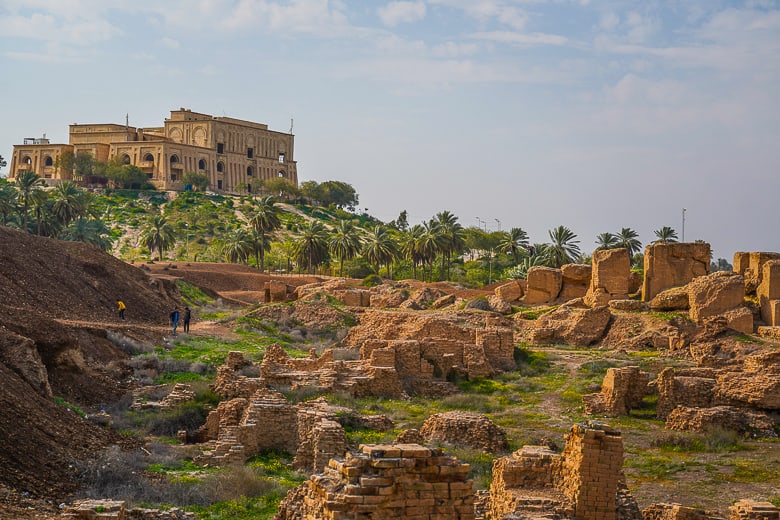
ruins of Babylon, courtesy, unusualtraveler.com
The legendary city of Babylon is today part of the Arab-occupied territory of Iraq. Thousands of years before the Arab occupation, it was the capital and center of the Babylonian Empire. Today, the descendants of the ancient Babylonians are the Iranian Christians, closely aligned with the Assyrian Christians of Iraq, and Babylon itself is an archaeological/historical site, part of the present-day city of Hillah, about 53 miles south of Baghdad. Originally, the Euphrates River bisected the city, but the course of the river has since shifted so that most of the remains of the former western part of the city are now inundated but some portions of the city wall remain. Other parts of the western half have been mined by Arabs for commercial building materials. Some of the nearby ancient settlements included KishBorsippaDilbat, KuthaMarad and Sippar all of them along the Euphrates.
The building of Babylon began many thousands of years ago. It was originally called Babel (as in, the Tower of Babel) a small Akkadian town dating from the period of the Akkadian Empire c. 2300 BCE. In Genesis 10:10, Babel is described as being founded by Nimrod along with UrukAkkad and perhaps Calneh—all of them in the land of Shinar. According to Genesis 11, there was but one human race, speaking one language, migrating to Shinar and eventually establishing a city and the famous tower. Soon, however, the God of the Bible halted construction by scattering humanity across the earth and confusing their language so that they were unable to communicate. Some scholars believe that the tower may have been inspired by a real-life temple, or ziggurat, built to honor Marduk, the patron god of Babylon and son of Shamash, the sun-god of Sippar.
The Akkadian king Šar-kali-šarri laid the foundations in Babylon of new temples for the gods Annūnı̄tum and Ilaba. The town became part of a small independent city-state with the rise of the First Babylonian dynasty in the 19th century BCE. After the Amorite king Hammurabi created a short-lived empire in the 18th century, he transformed Babylon into a major city and declared himself its king, southern Mesopotamia became known as Babylonia and Babylon eclipsed Nippur as its holy city. It has been estimated that Babylon was the largest city in the world c. 1770 – c. 1670 BCE, and again c. 612 – c. 320 BCE. It was perhaps the first city to reach a population above 200,000. 
The empire waned under Hammurabi's son Samsu-iluna and Babylon spent long periods under, and pillaged by, foreign empires such as the Assyrians, Hittites, Kassites, and Elamites. An Akkadian south Mesopotamian dynasty then ruled for the first time. However, Babylon remained weak and subject to domination by Assyria. Its ineffectual native kings were unable to prevent new waves of foreign West Semitic settlers from the deserts of the Levant, including the Arameans and Suteans in the 11th century BCE.  
Under the Assyrian emperor Sennacherib, Babylonia was in a constant state of revolt, led by a chieftain named Merodach-Baladan, in alliance with the Elamites, and suppressed only by the complete destruction of the city of Babylon. In 689 BCE, its walls, temples and palaces were razed. Destruction of the religious center shocked many, and the subsequent murder of Sennacherib by two of his own sons while praying to the god Nisroch was considered an act of atonement. Consequently, his successor Esarhaddon hastened to rebuild the old city and make it his residence during part of the year. After his death, Babylonia was governed by his elder son, the Assyrian prince Shamash-shum-ukin, who eventually started a civil war in 652 BCE against his own brother, Ashurbanipal, who ruled in Nineveh. Once again, Babylon was besieged by the Assyrians and eventually surrendered. An Assyrian governor named Kandalanu was then appointed as ruler of the city. After the death of Ashurbanipal, another civil war followed. Babylon, like many other parts of the near east, took advantage of the anarchy within Assyria to free itself from Assyrian rule. Under Nabopolassar, a previously unknown Chaldean chieftain, Babylon escaped Assyrian rule, and in an alliance with Cyaxares, king of the Medes and Persians together with the Scythians and Cimmerians, finally destroyed the Assyrian Empire between 612 BCE and 605 BCE.
With the recovery of Babylonian independence, a new era of architectural activity ensued, particularly during the reign of his son Nebuchadnezzar II (604–561 BCE). Nebuchadnezzar ordered the complete reconstruction of the imperial grounds, including the Etemenanki ziggurat, and the construction of the Ishtar Gate—the most prominent of eight gates around Babylon. Nebuchadnezzar is also credited with the construction of the Hanging Gardens of Babylon—one of the Seven Wonders of the Ancient World—said to have been built for his homesick wife Amyitis. Nebuchandnezzar is also notoriously associated with the Babylonian exile of the Jews from Judea, the result of an imperial technique of pacification, used also by the Assyrians, in which ethnic groups in conquered areas were deported en masse to the capital.
In 539 BCE, the Neo-Babylonian Empire fell to Cyrus the Great, king of Persia, who conquered Babylon. According to 2 Chronicles 36 of the Hebrew Bible, Cyrus later issued a decree permitting captive people, including the Jews, to return to their own lands. Under Cyrus and the subsequent Persian king Darius I, Babylon became the capital city of the 9th Satrapy, as well as a center of learning and scientific advancement. In Achaemenid Persia, the ancient Babylonian arts of astronomy and mathematics were revitalized, and Babylonian scholars completed maps of constellations.
The early Persian kings had attempted to maintain the religious ceremonies of Marduk, but by the reign of Darius III, over-taxation and the strain of numerous wars led to a deterioration of Babylon's main shrines and canals, and the destabilization of the surrounding region. There were numerous attempts at rebellion and in 522 BCE (Nebuchadnezzar III), 521 BCE (Nebuchadnezzar IV) and 482 BCE (Bel-shimani and Shamash-eriba) native Babylonian kings briefly regained independence. However these revolts were quickly repressed and Babylon remained under Persian rule until Alexander the Great's entry in 331 BCE.
Under Alexander, Babylon again flourished as a center of learning and commerce. However, following his death in 323 BCE in the palace of Nebuchadnezzar, a period of chaos and anarchy ensued which virtually emptied the city; most of the inhabitants were transported to Seleucia, where a palace and a temple (Esagila) were built. With this deportation, Babylon became insignificant as a city, although more than a century later, sacrifices were still performed in its old sanctuary.
In the first century, after the death of Jesus Christ, Christians in Syria and Judea faced severe persecution by the Romans and many of them moved east where they joined the ancient Jewish community in Babylon. Of those who moved east was Saint Thomas, a disciple of Jesus. He succeeded in converting the local inhabitants, from the Euphrates to Persia, to Christianity and established their own church which eventually became the seat of the Bishop of the Church of the East for many centuries afterwards. A new Christian culture was developed and the people would speak various forms of Aramaic. This was maintained even when the city came under the rule of the Parthian and Sassanid Empires and Babylon was designated as a province.
In the mid-7th century, Mesopotamia was invaded and settled by the expanding Arab Muslim Empire, and a period of Islamization and Arabization followed. Babylon was dissolved as a province and Aramaic and members of the Church of the East eventually became marginalized. Soon, the last of the inhabitants left and the city fell into ruins. Babylon is mentioned in medieval Arabic writings as a source of bricks, said to have been used in cities from Baghdad to Basra.
In the centuries that followed, travelers and archaeologists from Europe have visited Babylon. This included such people as Pietro della Valle in the 17th century and Pierre-Joseph de Beauchamp in the 18th whose memoir, published in English translation in 1792, provoked the British East India Company to direct its agents in Baghdad and Basra to acquire Mesopotamian relics for shipment to London.
The site of Babylon has been a cultural asset to Iraq since the creation of the modern Arab Iraqi state in 1921. In a bid to cultural appropriation, Iraq officially “protected” and “excavated” the site and Babylonian images periodically appeared on Arab Iraqi postcards and stamps. In the 1960s, a replica of the Ishtar Gate and a reconstruction of Ninmakh Temple were built on site. On February 14, 1978, the Ba'athist government under Saddam Hussein began the "Archaeological Restoration of Babylon Project": reconstructing features of the ancient city atop its ruins. These features included the Southern Palace of Nebuchandnezzar, the Processional Way, the Lion of Babylon, and an amphitheater constructed in the city's Hellenistic era. In 1982 the government minted a set of seven coins displaying iconic features of Babylon. A Babylon International Festival was held in September 1987, and annually thereafter until 2002 (excepting 1990 and 1991), to showcase this work. Proposed reconstruction of the Hanging Gardens and the great ziggurat never took place. Hussein installed a portrait of himself and Nebuchadnezzar at the entrance to the ruins and inscribed his name on many of the bricks, in imitation of Nebuchadnezzar. When the 1991 Gulf War ended, Hussein wanted to build a modern palace called Saddam Hill over some of the old ruins. In 2003, he intended the construction of a cable car line over Babylon, but plans were halted by the 2003 invasion of Iraq. Following the invasion, the area around Babylon came under the control of US troops, before being handed over to Polish forces in September. In 2005 the site was handed over to the Iraqi Ministry of Culture.
Known remains include:
·         Palace or Castle, it is the location of the Neo-Babylonian ziggurat Etemenanki and lies in the center of the site.
·         the highest of the mounds at 82 feet located in the southern part of the site is the site of Esagila, a temple of Marduk which also contained shrines to Ea and Nabu.
·         Homera – a reddish-colored mound on the west side. Most of the Hellenistic remains are here.
·         Babil – a mound about 72 feet high at the northern end of the site. It held a palace built by Nebuchadnezzar.