For the record, I'm neither an academic nor a scholar, and admittedly, I've never been to many of the places posted here. So if someone should find a mistake, or believe I omitted something, please feel free to email me and I'll correct it.

I can be contacted at dms2_@hotmail.com.

Sunday, November 29, 2020

MISHMAR HAEMEK

View of Mishmar HaEmek's new neighborhood
courtesy, Wikipedia
Mishmar HaEmek is a kibbutz in northern Israel, located in the southwestern part of the Jezreel Valley, between Highway 66 to its northeast and the foot of the Menashe Heights to its southwest. It falls under the jurisdiction of the Megiddo Regional Council and is one of the few kibbutzim that have not undergone privatization, still following the traditional collectivist and socialist kibbutz model.  Next to the kibbutz is Mishmar HaEmek Forest, planted by the Jewish National Fund and members of the kibbutz. It is a section of Megiddo Park (formerly named "Ramot Menashe park"), listed as a biosphere reserve by UNESCO. Flowing through Mishmar HaEmek is the Nahal Mishmar HaEmek, a tributary of the Kishon River. Some of the waters also come from the Spring of Shulamit. In 2019, it had a population of 1,271. At least six former members of the Knesset hail from Mishmar HaEmek.

In Biblical times, the site of Mishmar HaEmek was allotted to the tribe of Menasheh (on the west side of the Jordan) in the northwestern section of the tribal territory between Megiddo and Yokneam. The present kibbutz sits near the ancient site of Tel Shush which Israeli geographers and archaeologists have identified as the ancient Jewish village of Geva‘ Parashim from the time of the Hasmonean dynasty. Between the Arab conquest in the 7th century and the 1920s, Bedouin and Turkmen tribes settled in the area, founding the settlement of Abu Shusha.  In the 1870s, much of the Jezreel Valley came under the ownership of the Sursock family, a Greek Christian family in Lebanon. From 1924 to 1926, the land in and around the area of the present kibbutz, including Abu Shusha, was purchased by the Jewish National Fund.

The pioneers of Mishmar HaEmek came to Mandatory Palestine during the Third Aliyah. They were Polish Jews from Galicia and were members of three groups who graduated from the HaShomer HaTzair movement, one from the town of Afula and two from the Jerusalem area. They later joined with another Zionist socialist group from Hadera and on November 3, 1926, the members (numbering 90 after the unification) were given the land next to Abu Shusha. But initially, only 15 men and women went to the site, and they settled in a nearby khan, from where they began preparing for agricultural work. In the next year, two mules were bought and 120 dunams of wheat and barley were sowed. Soon, the pioneers left the khan and began building the new settlement in its present location, making history as the first Jewish settlement in this part of the valley since Biblical times. As a HaShomer HaTzair stronghold, the settlement housed many pioneers of other kibbutzim and instructed them before they established their own kibbutzim.

In November 1928 the kibbutz was renamed "Kibbutz Mishmar HaEmek" as proposed by Menachem Ussishkin, after its members could not agree on a name. On August 26, 1929, during the bloody Arab riots, the kibbutz was attacked. The members, with the aid of Arab policemen, managed to fend off the rioters. British policemen ordered the kibbutz to evacuate and promised to take care of their property, and so the members left the following day. On August 28, Arab rioters burned the barn, uprooted trees, stole corn from the fields and vandalized two gravestones in the cemetery. It was the only time in its history where Mishmar HaEmek was abandoned, and it joined 16 other Jewish communities that were also abandoned during the riots. But unlike the others, it was resettled six days later. 

In 1931, Shomeria School was established as the first regional educational institution of the Kibbutz Artzi movement, an ideological ally of Hashomer HaTzair. It soon became the biggest structure in the region and operated as a boarding school. It put into practice HaShomer HaTzair's socialist ideology, creating an independent "children's society." The pupils saw their parents only on holidays or special visiting days throughout the year. This institution provided education to several other kibbutz communities that were established in the Jezreel Valley as well as youth from the Youth Aliyah. In the mid-30s, the members also constructed a water tower, built a cowshed, planted a vineyard and various fruit trees, and dug wells. Berta Guggenheimer was an activist who planned playgrounds all over the country and with her niece Irma Lindheim, a member of Mishmar HaEmek, set up the kibbutz’s own children's playground. There was also an arrangement to allow Arab children from the nearby villages to visit and play with the kibbutz children.

At the start of 1936–39 Arab revolt in Palestine, Mishmar HaEmek came under attack from nearby Arab settlers under the command of Ahmad Attiyah Awad, succeeded by Yusuf Abu Durra after his death. There were repeated arson attacks on grain fields and forests and were described by a member as a "crime greater than murder," as the burning of the wheat fields denied the members their main food source. Around 30,000 trees in the kibbutz's vicinity were destroyed and an enormous amount of property was lost. There were no direct attacks on the kibbutz itself, but almost every night there were stray shots fired in its direction. Many of the kibbutz men had to spend time guarding instead of working the fields. British High Commissioner Arthur Grenfell Wauchope visited the kibbutz and appointed 15 members as armed guards; however, in August 1936, the situation worsened when the attacks became more frequent. The British government sent 60 soldiers to the kibbutz and by October the attacks on the kibbutz ended. But not ambushes. On February 2, 1938 Abraham Goldschleger, a kibbutz member and guide for Ein HaShofet, was ambushed and murdered by the Arab settlers of Al-Kafrayn. Two residents of Ein HaShofet who accompanied him were also killed in the attack. One of the shooters was caught and executed. 

During World War II, the nearby Palmach Cave was chosen by the Palmach upon its establishment in 1941, as a training site for its special undercover units. The cave was also used for meetings between Palmach commanders. In the fall of 1942, Mishmar HaEmek was used as a training camp by the British army. 160 Jewish volunteers, members of Palmach,  were trained by Royal Engineers in sabotage and wireless operations. Several tons of explosives were hidden in caches in case the area came under German occupation. This program was eventually terminated and orders were issued for the collection of all equipment and explosives to be returned to the British.

In 1947, the Jewish National Fund and Worton Hall Studios made a movie entitled The Great Promise (Dim'at Ha'Nehamah Ha'Gedolah), and a number of scenes were filmed in Mishmar HaEmek. By 1947, Pinat HaGola ("Diaspora's Place") was built by the sculptor Zeev Ben Zvi as a memorial site for the children who died in the Holocaust. He built it with the students of the kibbutz. It was the earliest memorial site for the Holocaust in Israel.

On April 4, 1948, during the War of Independence, the kibbutz came under full-scale attack by the Arab Liberation Army (ALA). The leader of the ALA, Fawzi al-Qawuqji, planned to seize Mishmar HaEmek in order to control the route between Jenin and Haifa. The attack began with a barrage from seven artillery pieces supplied by the Arab army of Syria. During the shelling, houses were destroyed, civilians, defenders, and animals were killed and the prominent school building was heavily damaged. A bomb shelter was later built there. The Pinat HaGola was also damaged by a shell, but Ben-Zvi refused to repair it. On April 6, the women and children of the kibbutz were evacuated to other settlements in the Jezreel Valley and a ceasefire began during which the Jewish forces fortified the kibbutz and dug trenches around its perimeter.  

Although the Arab forces had not entered the kibbutz, Qawuqji reported that the kibbutz was captured and the "conquest of Mishmar HaEmek" was falsely celebrated in Arab newspapers, which also reported heavy casualties among the Jewish forces. The ALA sent terms to the Haganah, saying they would lift the siege of the kibbutz, regroup and move toward Haifa if the Jewish forces would not retaliate against the nearby Arab villages in return. The Jewish forces declined the offer and the Arab offensive resumed on April 8. That night, the Jewish forces launched a counter-attack under the command of Yitzhak Sadeh and captured the nearby Arab village of Al-Ghubayya al-Fawqa in a fierce battle. In the next days, troops of the Carmeli Brigade and the Palmach unit captured several other villages near Mishmar HaEmek and nearby Ein HaShofet, and destroyed them all. During the second phase of the war, on December 24, Iraqi planes bombed the kibbutz, hitting the children's house, killing four children and injuring another four.

After the war, in 1950, the kibbutz finished building a new large dining hall and kitchen, whose construction was delayed during the war. That same year, the people of Mishmar HaEmek established a plastics factory called Tama, which in time became a central part of the kibbutz's economy. The factory was created to provide work for the elderly, since at the time Mishmar HaEmek had the highest number of elderly residents among the entire Kibbutz Artzi network. In the 1970s, a 25% stake was sold to Kibbutz Gal’ed.

In May 1950 an adjacent village and ma'abara (immigrant transit camp) called Keren Yesha was established for Yemenite Jews by the Jewish Agency. It was located atop Tel Shush, where the first members of the kibbutz settled in 1926. Eventually, political rivalries affected the relations between the two communities. The Hed Ha-Mizrach newspaper described life in Keren Yesha two months after its establishment, stating that the Yemeni immigrants lived in tents and although the residents claimed to be content, they also said that there was not enough support by the authorities. The newspaper Al HaMishmar, affiliated with the Kibbutz Artzi movement, reported that the kibbutz helped the new community and provided a number of services to the new immigrants. The newspaper reported that the Moshavim Movement, which held rival social and political views, was officially responsible for Keren Yesha, and asked that the kibbutz would cease its aid, telling the residents that they needed to choose between aid from Mishamr HaEmek or the Moshavim Movement.

In July 1951, Keren Yesha protested against negligence by the authorities and blocked the nearby road. The newspaper Davar, affiliated with the Mapai party, reported that the protest was organized by the members of Mishmar HaEmek affiliated with the rival Mapam party and also claimed they have denied water and medical treatment to the immigrants after they decided to support Mapai. This report caused outrage among kibbutz members, who denied the accusations and claimed that the relations between both communities are good and that the kibbutz provides the village with the support that the authorities fail to the deliver. Later, Davar issued an apology, saying it was a false report. In 1953, Keren Yesha was abandoned and the residents moved to nearby Midrakh Oz.

Mishmar HaEmek suffered from the 1983 bank stock crisis. In an attempt to save the kibbutz from bankruptcy, Tama began manufacturing plastic netting used for bundling crops and in the late 1980s the crisis ended. Several successful business moves by Tama in the early 1990s led the kibbutz to an era of economic prosperity and high quality of life. During that period, education in the kibbutz was reformed, the children's societies were abolished, and the pupils were moved to schools outside of the kibbutz. This allowed the kibbutz to extend existing houses and set up new neighborhoods. Prosperity led the kibbutz to increase the salaries of its members, to create personal funds for families, and to institutionalize culture and recreational activities thanks to the weekly labor days, reduced to five.

On April 1 1990, 15,000 people (according to Maariv) participated in a parade from the Menashe forest to Mishmar HaEmek in protest of the objection of Rabbi Elazar Shach to prevent a political coalition between the Haredi parties and the leftist parties which he described as "eaters of hares and swine" (non-Kosher food). Many leaders of the Israeli left and right participated in the parade. In August, some members of the kibbutz and those of Kibbutz Artzi-affiliated kibbutzim, signed a petition calling upon the kibbutz movement to launch a non-violent protest against Israel Defense Forces actions against murderous Palestinians in Judea and Samaria during the First Intifada. The residents of Mishmar HaEmek represented the more Arab-friendly and peace-oriented left-wing of the Israeli Labor Movement. Some of the movement's leaders, such as Mordechai Bentov and Ya'akov Hazan, hailed from the kibbutz.

In 2010 the kibbutz decided, after a series of public meetings, to appoint a team of members to discuss the privatization of electricity, food, mail, barbershop and cosmetics. Other services were to be kept under the responsibility of the kibbutz, including healthcare, education and welfare. The dispute mainly concerned the privatization of the dining room. At the end of the discussions, most privatization initiatives were rejected and only a few minor changes that had no practical effect on the collective lifestyle were accepted.

Various services have developed in the kibbutz; some of them are operated privately by the kibbutz members, such as the "IDEA Information System", which provides software for 70% of the museums in Israel, including Yad Vashem. In 2019 the kibbutz finalized a deal with the kibbutzim of Evron and Sa'ar to buy a quarter of their share of a company called Bermad, estimated to be worth around 450 million NIS. The company manufactures water control products that are provided to over 70 other companies, with annual revenue of half a billion NIS, employing around 700 workers.

Other sites in Mishmar HaEmek include: the Plant Nursery, the Basketball Hall, the Winery, the Mishmar HaEmek Cemetery, and the Mishmar HaEmek Battle Memorial Monument.

Sunday, November 22, 2020

MIKVEH YISRAEL

administration building, Mikveh Yisrael agricultural school,
courtesy, Times of Israel
Mikveh Yisrael is a youth village and boarding school in the Tel Aviv District of central Israel, established in 1870. It was Israel’s first Jewish agricultural school and indeed the first modern Jewish settlement in Palestine outside of Jerusalem, heralding a new era in the history of the region.

In Biblical times, the site of present-day Mikveh Yisrael was allotted to the tribe of Dan. It was in close proximity to Jaffa, the port city of ancient Israel. In the final decades of the Ottoman Empire, this area would see intense Jewish activity. About 1860, several orthodox rabbis, among whom were Zvi Hirsch Kalischer and Elijah Gutmacher, developed a plan for the colonization of Palestine with Russian and Rumanian Jews. This plan was soon after supported by the Maskilim (Progressists). The latter induced the Alliance Israélite Universelle, of Paris, to interest themselves in the matter, notwithstanding the circumstance that many members of the Alliance doubted the adaptability of the Jews to agricultural work. When Charles Netter, emissary of the Alliance, visited Israel in 1868, he visualized an agricultural school surrounded by a settlement as the beginning of a future network of Jewish villages. And in April 1870, Mikveh Yisrael was founded on a tract of land southeast of Jaffa leased from the Ottoman Sultan, who allocated 750 acres to the project. The name was taken from two passages in the Book of Jeremiah, 14:8 and 17:13, and was proposed by Wolf Grinstein, one of the school's first students, who later taught there. Netter was the first director of the school and it aimed to be an educational institution where young Jews could learn agriculture, learn new methods, and thus giving them the means to establish villages and settlements all over the country and to make the desert blossom. Mikveh Yisrael was credited with introducing the eucalyptus tree from Australia for the purpose of draining the swamps. It soon gained the support of the Anglo-Jewish Association. In 1882 the first *Bilu pioneers found work and were trained there immediately upon arrival in the country. Baron Edmond James de Rothschild contributed to the upkeep of the school.

Netter was succeeded by Joseph *Niego who directed the school from 1891 to 1914. In 1898, Theodor Herzl met the German Emperor Wilhelm II at the settlement’s main entrance. 

From 1914 to 1955, the school was under the direction of Eliyahu Krause. During his tenure, Mikveh Yisrael became a pioneering ground for the introduction and improvement of new farm branches. Hebrew became the language of instruction soon after Krause had taken over. For many decades the school served as the research center for the country. Their teachers wrote the first study books about agriculture and served as field advisors. Most of the agricultural know-how of the first 50 years was collected and published by Mikve Yisrael. After finishing their studies, the thousands of graduates left Mikve Yisrael to start agricultural settlements of all kinds, villages and kibbutzim, moshavim, farms and agricultural schools; or serving in management positions; or continued their agricultural studies in institutions of higher learning and filling positions in research and development, the export branches, marketing and agricultural management.

The botanical garden was established in 1930 in order to adapt and acclimate trees and species to the Israeli climate. Plants were imported from all over the world. It now covers now 70 dunams.

Since the 1930s Mikveh Yisrael has become an important education center for *Youth Aliyah. In 1938–1939, at the request of the Youth Aliyah, a section for religious youth was built to house the religious and traditional youngsters who fled western Europe just before the start of the Holocaust. It occupied 1.2 sq. mi. and included a cultural center, a library named after Krause, experiment stations, and a botanical garden featuring over 1,000 species. Agriculture included field crops, fruit orchards, citrus groves, greenhouse crops, sheep, poultry, and bees.

In the Israel *War of Independence (1948), the school was attacked several times. In 2007 Mikve Yisrael and the Alliance Israélite Universelle inaugurated an experimental bilateral Israel-France high school, the Collège-Lycée franco-israélien Raymond Leven, with half of its pupils studying for the French Baccalauréat and half for the Israeli Bagrut

The agricultural grounds of Mikve Yisrael cover over 2,200 dunams (out of a general area of 3,300 dunams). Most of the fields are irrigated using wells and include field crops, industrial crops, vegetables, fruit trees, orange groves and greenhouses. The school also raises animals including milk cows, chickens and honey bees, as well as having auxiliary branches including computerized agriculture.

One dunam is covered by greenhouses. The aim of the greenhouse production branch is to allow students to research greenhouse issues and technologies. A rainwater harvesting system allows efficient re-use of water collected from the roof for growing of vegetables in greenhouses.

Also on the premises, a stable was established having the following breeds of riding horses: Hanoverian, Holland and quarter-horse breeds suited to all types of horseback riding: western, sports, and therapeutic riding.

Mikveh Yisrael has been instrumental in developing novel techniques in citrus and other farm branches, introducing avocado cultivation and the acclimatization of many livestock strains, and while it operated the Mikveh Yisrael wine cellars, select wines and liqueurs were produced.


Tuesday, November 10, 2020

MERON

yeshiva and entrance to Tomb of Shimon bar Yohai, Meron, courtesy, TheYeshivaWorld.com

Meron is a town in northern Israel with a population of 985 as of 2019. Located on the slopes of Mount Meron in the Upper Galilee near Safed, it falls under the jurisdiction of the Merom HaGalil Regional Council. The town is most famous for the Tomb of Rabbi Shimon bar Yochai, a rabbi renowned for his mysticism who, it is alleged, wrote the kabbalistic book, the Zohar, and is adjoined to an ancient yeshiva. The tomb is the site of the annual mass public commemoration of Lag Ba'Omer.

In the Bible, Meron is mentioned as the site of Joshua's victory over the Canaanite kings and its subsequent allotment to the tribe of Naphtali. Josephus fortified Meron in the 1st century CE and called the town Mero or Meroth. It is mentioned in the Talmud as being a village in which high-quality olive oil was produced and many sheep were reared. It has been suggested that merino, the celebrated wool, may have had its etymological roots in Meron. In the last decade of the 3rd century CE, a synagogue was erected. Known as the Meron synagogue, it survived an earthquake in 306 CE, though excavations at the site indicate that it was severely damaged or destroyed by another earthquake in 409 CE. It has remained in ruins ever since and has become a major landmark. Some time in the 4th century CE, Meron was abandoned for reasons as yet unknown but was later reoccupied some time between 750 and 1399. In the 12th century, Benjamin de Tudela visited Meron and described a cave with tombs, believed to hold the remains of HillelShammai, and "twenty of their disciples and other Rabbis". The French Rabbi Shmuel ben Shimshon, while on a visit to Meron in 1210, located the tombs of Shimon Bar Yochai and his son Eleazar b. Simeon. He also stated that there were 336 other tombs, and outside of the village, the tombs of Simeon Ḥaṭufah and of the prophet Obadiah. From the 13th century onward, Meron became the most frequented site of pilgrimage for Jews in Palestine. In the early 14th century, Arab geographer al-Dimashqi reported that Jews and possibly non-Jewish locals travelled to celebrate a festival, which involved witnessing the sudden and miraculous rise of water from basins and sarcophagi in the cave. A similar scene was also described by the 15th century Italian rabbi, later Chief Rabbi of Israel, Ovadiah di Bertinoro, the Italian traveler Rabbi Moshe Basola in the 16th century and by the American archaeologist Edward Robinson in the 19th. It has been a custom at the Meron celebrations, dating from the time of Rabbi Isaac Luria, that three-year-old boys are given their first haircuts (upsherin), while their parents distribute wine and sweets. It was reported that during the earthquake of 1837, the walls of the tombs of Rabbi Eleazer and Rabbi Shimon were dislodged, but did not collapse. Laurence Oliphant visited Meron sometime in the latter half of the 19th century. His guide there was a Sephardic rabbi who owned the land that made up the Jewish quarter of the village. Oliphant writes that the rabbi had brought 6 Jewish families from Morocco to till the land, and that they and another 12 Muslim families made up the whole of the village's population at the time.

Towards the end of World War I, the ruins of the Meron synagogue was acquired by the "Fund for the Redemption of Historical Sites" (Qeren le-Geulat Meqomot Histori'im), a Jewish society headed by David Yellin.

Today, the modern moshav Meron is located at the foot of Mt. Meron, and is affiliated with the Ha-Po'el ha-Mizrachi Moshavim Association. Founded in 1949, near the yeshivah and remnants of the ancient Meron synagogue, by immigrants from Hungary and Czechoslovakia, it specialized in hill farming, with deciduous fruit orchards, dairy cattle, and poultry.

On July 14, 2006, a Katyusha rocket fired from Lebanon exploded in Meron, claiming 2 lives—Yehudit Itzkovich, 57, and her 7-year-old grandson Omer Pesachov—and injuring four others. A new barrage of rockets hit Moshav Meron on July 15; there were no injuries.

Among the local attractions are the Meron Vineyards. Meron is conducive to growing grapes for wine as a result of its 600-meter altitude and chalky soil. The vineyard was first planted in 2000 and is part of the Galil Mountain Winery, headquartered in nearby Kibbutz Yiron. 

Sunday, November 1, 2020

TRIBE OF MENASHE

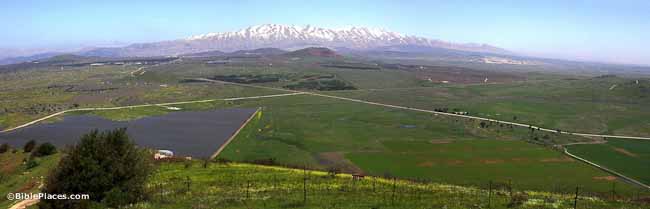
the eastern part of Menashe today, courtesy, BiblePlaces.com
For previous postings about parts of Menashe, see Samaria and Bashan/Golan Heights.

Menasheh was born in Egypt, the first born of Joseph by Osnat, daughter of Potiphar, priest of On. According to Genesis 41:51, Joseph named him “Menasheh” because “…god has made me forget (נשני Nashani  ) all my toil…” referring to the time when he was sold by his brothers to a caravan going to Egypt, and his subsequent imprisonment in Egypt. The Bible refers to the descendants of Menasheh as a “half tribe”, probably because he was not the son of Jacob. By the time the Children of Israel were on the edge of the Promised Land, Menasheh was divided into east and west. The eastern portion of the tribe settled in their lands first. In Numbers 32:33 and 39, it is stated that eastern Menasheh took possession of the lands of Gilead and Bashan, which stretched as far as the town of Edrei in the east and, what is now known as the Golan Heights in the west. The cities of eastern Menasheh are listed in scattered places in the Bible, but mainly in Numbers 32:41 and Joshua 13:30-31: Ashtarot, a royal city of Bashan, Edrei, another royal city where Og, King of Bashan, was defeated and his lands given over to Menasheh, Golan, set aside by Joshua as a city of refuge and was held by the Gershon branch of the Levites, the Havot Yair bloc, Nobah, and Salchah. Of Salchah nothing is known but the fact that it was a boundary city.

The western portion of the tribe took possession of its land during the time of Joshua. Roughly, this territory consisted of the lands from the Carmel mountain range and across the Jezreel Valley to the Jordan, including the towns of Megiddo and Bet She’an in the north, and going southward, until the northern border of Jaffa in the west, the southern border of Shechem in the center, and the southern border of Gilgal in the east, thus, consisting of the bulk of the Jordan Valley. The cities of Menasheh on the west side of the Jordan, many of which were shared with the tribe of Ephraim, are listed in Joshua 17: Bet She’an, Dor, Ein Dor, Ible’am, Megiddo, Michmetah, Taanach, the area that became Haifa, Ein Tappuah, Gilgal, Shechem, and Shomron.

Wednesday, October 21, 2020

MOROCCO

The village of Imlil in the high Atlas Mountains of Morocco near Toubkal Stock Photo - 26513537
indigenous Amazigh (Berber) village, Morocco, courtesy,
123rf.com

Morocco is an Arab-occupied country located in the Maghreb region of North Africa. It overlooks the Mediterranean Sea to the north and the Atlantic Ocean to the west, with land borders with Algeria to the east and Western Sahara (status disputed) to the south. In addition to the Western Sahara, Morocco also claims the exclaves of CeutaMelilla and Peñón de Vélez de la Gomera, all of them under Spanish jurisdiction, as well as several small Spanish-controlled islands off its coast. The indigenous people presently living under Arab occupation are from various Berber tribes, mainly, the Chleuh, Riffian, Sanhaja, Zayane, and Zenata.

Thousands of years ago, various Berber tribes settled in the area. Medieval Arab historian Ibn Khaldun (1332–1406) brings down two opinions as to the Berbers' origin, writing that some say that they were descended from Canaan, son of Ham. But citing Abu Bakr bin Yahya al-Suli, Ibn Khaldun wrote that they are descended from Casluhim, the son of Mizraïm. Beginning around the 9th century BCE, this area would slowly be drawn into the wider emerging Mediterranean world by the Phoenicians, who had established trading colonies and settlements including VolubilisChellah and Mogador. These centers were trading hubs, and later offered support for resource development such as olive oil at Volubilis and Tyrian purple dye at Mogador. For their part, most Berbers maintained their independence as farmers or semi-pastorals although, due to the exemplar of Carthage, their organized politics increased in scope and acquired sophistication. In 225 BCE, the Berber Mauri under their king Baga, began to inhabit ancient Mauretania (not to be confused with the present state of Mauritania). It later became a realm of the Northwest African civilization of ancient Carthage as part of its empire. It became a client kingdom of the Roman Empire in 33 BCE. In 44 CE, under the reign of King Ptolemy of Mauretania, the last king of Mauretania, Emperor Claudius annexed the country directly as a Roman province to be ruled by an imperial governor. The Mauretanian cavalry fought in the Dacian Wars under the indigenous military leader Lusius Quietus. During the crisis of the 3rd century, parts of Mauretania were reconquered by Berber tribes. Direct Roman rule then became confined to a few coastal cities, such as Septum (Ceuta) in Mauretania Tingitana and Cherchell in Mauretania Caesariensis. The Roman Empire lost its remaining possessions after the area was devastated by the Vandals in 429. Afterwards, local Mauro-Roman kings assumed control. The Eastern Roman Empire under Byzantine control re-established direct imperial rule in the 530s.

The Muslim conquest of the Maghreb, that started in the middle of the 7th and into the 8th centuries, was achieved by the Arab Umayyad Caliphate early into the following century. It brought both the Arabic language and Islam to the area. Although part of the larger Islamic Empire, Morocco was initially organized as a subsidiary province of Ifriqiya, with the local governors appointed by the Muslim governor in Kairouan. Even though the indigenous Berber tribes adopted Islam, they retained their customary laws. They also paid taxes and tribute to the new Muslim administration. Some achieved a high status in society under the new rulers. Tariq ibn Ziyad, Berber Muslim and Umayyad general, led in the Muslim conquest of Spain in 711.

The following are the Berber rulers of Morocco under the various indigenous dynasties:

Banū Salih rulers

·         Salih I ibn Mansur "al-`Abd as-Salih" (710-749) founder of the first independent Muslim state in Morocco and with its capital at Temsaman. This kingdom would later exist alongside the Barghawata kingdom.

·         al-Mu'tasim ibn Salih (749-?)

·         Idris I ibn Salih (?-760), who founded Nekor and made it capital of the kingdom.

·         Sa'id I ibn Idris (760-803)

·         Salih II ibn Sa'id (803-864)

·         Sa'id II ibn Salih (864-916)

·         Salih III ibn Sa'id (917-927)

·         Abd al-Badi' ibn Salih "el-Mu'ayyid" (927-929)

·         Abu Ayyub Isma'il ibn 'Abd al Malik ibn Abd ar-Rahman ibn Sa'id I ibn Salih (930?-935)

·         Musa ibn Rumi ibn Abd as-Sami` ibn Salih ibn Idris I ibn Salih (936?-940)

·         Abd as-Sami' ibn Jurthum ibn Idris ibn Salih I ibn Mansur (940-947)

·         Jurthum ibn Ahmad ibn Ziyadat Allah ibn Sa'id I ibn Idris (947-970)

Thenceforth, the kingdom remained in his line until the Azdâji emir Ya'la ibn Futuh conquered it in 1019 and expelled the family.

Barghawata kings

·         Tarif al-Matghari began a revolt against the Arab Umayyad occupation authorities that ultimately gave the Barghawata their independence.

·         Ṣāliḥ ibn Tarīf (744-?), declared himself prophet in 744 and went away at the age of 47, promising to return. Possibly during the reign of his successor, an Arab kingdom under the Idrisid dynasty arose alongside the Barghawata. It was they who allowed Arab immigrants to colonize and occupy Morocco, often coming into conflict with the Barghawata for the duration of the kingdom as a result.

·         Ilyas ibn Salih (?792-842)

·         Yunus ibn Ilyas (?842-888)

·         Abu-Ghufayl Muhammad (?888-917)

·         Abu al-Ansar Abdullah (?917-961)

·         Abu Mansur Isa (?961-?)

Almoravid dynasty

·         Abdallah ibn Yasin (1040–1059) – founder & spiritual leader, made Aghmat the Almoravid capital.

·         Yahya ibn Ibrahim (1048)

·         Yahya ibn Umar al-Lamtuni (c. 1050–1056)

·         Abu Bakr ibn Umar (1056–1087) – moved the capital to Marrakesh.

·         Yusuf ibn Tashfin (c. 1072–1106)

·         Ali ibn Yusuf (1106–43)

·         Tashfin ibn Ali (1143–45)

·         Ibrahim ibn Tashfin (1145–1147)

·         Ishaq ibn Ali (1147)

Almohad caliphs (1121–1269)

·         Ibn Tumart 1121–1130 made Tinmel the capital of the kingdom.

·         Abd al-Mu'min 1130–1163 moved the capital back to Marrakesh where he established the Kutubiyya Mosque.

·         Abu Ya'qub Yusuf I 1163–1184

·         Abu Yusuf Ya'qub 'al-Mansur' 1184–1199

·         Muhammad al-Nasir 1199–1213

·         Abu Ya'qub Yusuf II 'al-Mustansir' 1213–1224

·         Abu Muhammad Abd al-Wahid I 'al-Makhlu' 1224

·         Abdallah al-Adil 1224–1227

·         Yahya 'al-Mutasim' 1227–1229

·         Abu al-Ala Idris I al-Ma'mun, 1229–1232

·         Abu Muhammad Abd al-Wahid II 'al-Rashid' 1232–1242

·         Abu al-Hassan Ali 'al-Said' 1242–1248

·         Abu Hafs Umar 'al-Murtada', 1248–1266

·         Abu al-Ula (Abu Dabbus) Idris II 'al-Wathiq' 1266–1269

Marinid rulers

·         Abd al-Haqq I (1215–1217), capital in Taza.

·         Abu Sa'id Uthman I (1217–1240)

·         Abu Ma'ruf Muhammad I (1240–1244)

·         Abu Yahya ibn Abd al-Haqq (1244–1258), moved capital to Fez.

·         Abu Yusuf Yaqub (1258–1269)

·         Abu Yusuf Yaqub (1269–1286)

·         Abu Yaqub Yusuf al-Nasir (1286–1307)

·         Abu Thabit 'Amir (1307–1308)

·         Abu al-Rabi Sulayman (1308–1310)

·         Abu Sa'id Uthman II (1310–1331)

·         Abu al-Hasan 'Ali (1331–1351)

·         Abu Inan Faris al-Mutawakkil (1348–1358)

·         Abu Zayyan Muhammad II (1358; first reign)

·         Abu Yahya Abu Bakr ibn Faris (1358–1359)

·         Abu Salim Ibrahim ibn 'Ali (1359–1361)

·         Abu 'Amr Tashfin ibn 'Ali (1361)

·         Abu Zayyan Muhammad II (1361–1365; second reign)

·         Abu Faris Abd al-Aziz I al-Mustansir (1365–1372)

·         Abu Zayyan Muhammad III (1372–1374)

·         Abu 'l-Abbas Ahmad I al-Mustansir (1373–1384, 1387–1393)

·         Abu Faris Musa ibn Faris (1384–1386)

·         Abu Zayyan Muhammad IV ibn Ahmad I (1386)

·         Abu Zayyan Muhammad V ibn Ali (1386–1387)

·         Abu 'l-Abbas Ahmad II ibn Ahmad I (1387–1393)

·         Abu Faris Abd al-Aziz II ibn Ahmad II (1393–1396)

·         Abu 'Amir Abdallah ibn Ahmad II (1396–1397)

·         Abu Sa'id Uthman III (1398–1420)

·         Abu Muhammad Abd al-Haqq II (1420–1465)

The Wattasid Viziers, capital continued to be Fez

·         1420-1448: Abu Zakariya Yahya al-Wattasi

·         1448-1458: Ali ibn Yusuf

·         1458-1459: Yahya ibn Abi Zakariya Yahya

·         In 1465 came the raids and conquests by the Portuguese.

Wattasid Sultans

·         1472-1504: Abu Abd Allah al-Sheikh Muhammad ibn Yahya

·         1504-1526: Abu Abd Allah al-Burtuqali Muhammad ibn Muhammad

·         1526-1526: Abu al-Hasan Abu Hasan Ali ibn Muhammad

·         1526-1545: Abu al-Abbas Ahmad ibn Muhammad

·         1545-1547: Nasir ad-Din al-Qasri Muhammad ibn Ahmad

·         1547-1549: Abu al-Abbas Ahmad ibn Muhammad

·         1554-1554: Abu al-Hasan Abu Hasun Ali ibn Muhammad

Since that time and until today, Morocco had been succeeded by a series of Arab occupation dynasties.

Since the 16th century, Morocco managed to avoid the Ottoman conquests. In 1893-1894, the Melillan War broke out between the Berber tribes of the Rif and the Spanish invaders. Unfortunately, the Spanish emerged victorious. France also had had a strong influence on the country and in 1912, Morocco was divided into French and Spanish protectorates, with an international zone in Tangier.

During World Wars I and II and the Spanish civil war, several divisions of Goumiers or regular troops and officers largely made up of Berbers and some Arabs served in the French army. Between 1921 and 1926, a Berber uprising in the Rif Mountains, led by Abd el-Krim, against the French and Spanish, led to the establishment of the Republic of the Rif. The Spanish alone lost more than 13,000 soldiers at Annual in July–August 1921. The rebellion and the Rif Republic were eventually suppressed by French and Spanish troops. In 1956, Morocco gained its independence but as an Arab-occupied country.

While Berberism had its roots before the independence Morocco and the rest of the Maghreb, it was limited to the Berber elite. It only began to gain success among the greater populace when North African states replaced their European colonial languages with Arabic and identified exclusively as Arabian nations, downplaying or ignoring the existence and the social specificity of Berbers. In Morocco, after the constitutional reforms of 2011, Berber became an official language, and is now taught as a compulsory language in all schools regardless of the area or the ethnicity.

But in spite of the constant Arab discrimination, Berbers have actually reached high positions in the social hierarchy across the Maghreb, for instance, many of the prime ministers of Morocco were Berber including the present incumbent (as of this writing) Saadeddine Othmani.